
 L Lemo-Opuscar
构成主义蒙太奇
帝国大厦的小册子写着建造者,工地实拍和老照片给出答案:每天 2,500 人。
- 适合:
- 有力量的号召
- 系列:
- L Lemo-Opuscar
- 更新:
- 2026-10-29
风格提示词
Constructivist Montage — Style Prompt
Real archive footage, photographs and documents, printed as one ink-and-paper poster with a single red, and cut on a machine beat. Diagonal bands carry the type; windows cut along the axis hold the film; people are scissored out of photographs and stacked into structures; numbers count, documents are marked in red, and two images collide to make a third idea.
References (grammar only): Soviet montage cinema of the 1920s (city symphonies with split screens, counting and machine rhythm; "intellectual" montage where A + B yields a concept), constructivist posters and photomontage (red / black / paper, steep diagonals, photo cut-outs with geometric blocks, type as structure). Never copy their shots, layouts, slogans or lettering, and never name them in the film.
1. Essence, and what it is not
- Evidence, recut. Every picture is real material (archive film, photographs, documents) about the actual subject. The film's argument comes from how they are cut and set, not from illustration.
- One printed sheet. All material is converted to the same two-tone print (warm ink → paper); red is the only colour and is laid on top as a printed element.
- The beat is the editor. Cuts, slams, wipes and counts sit on a 120 BPM grid (or the score's tempo); sections accelerate by halving shot length.
- Type is structure. Words and numbers are beams: on a −18° band, as solid blocks, stacked vertically. Never floating captions.
- The collective over the individual. Crowds, hands, machines and many small figures; a single face is never the protagonist.
Not Data Storytelling or a keynote: no centred headline with bullets, no slide transitions, no header bars; data appears as marked documents, counters and measured bars inside the composition. Not Swiss Motion Graphics: asymmetric, diagonal, no grid of white space, no thin rules as decoration. Not Art Deco or 60s Spy Titles: no gold, no fine lines, no jazz. Not a museum slideshow: archive material is never shown "as is" in a neutral frame; it is cut, windowed, stacked and counted.
2. Materials & rendering
- Four kinds of element only: bands (red or ink, along the axis), windows (rectangles or parallelograms holding film or photographs), cut-outs (people scissored from photographs with a paper-white border), type blocks. Plus one paper-fibre texture over everything.
- The print grade (one function for film, photos and documents): luminance → percentile stretch (film: one pair of percentiles per clip, so it never pumps; 0.7 / 99.5; photos 0.8 / 99.4) → S-curve
x + s·(x−0.5)·(1−|2x−1|)·2, s = 0.32 (documents 0.18, they keep their paper) → map to ink→paper:rgb = INK + (PAPER − INK)·g. Archive film keeps a ±2.5 % per-frame flicker inside its window (hash(frame)), photographs and documents do not. - Cut-outs: a person-segmentation model (u2net_human_seg via onnxruntime) → threshold 0.5 → median filter → largest component → 7 px paper border dilated outside the mask. The border is the medium's own look and hides the model's edge errors. Group photos rarely segment cleanly: use them whole in windows.
- Documents: scans at full resolution, never retyped. They are marked: a red highlighter bar in
multiplyover the exact sentence, a hand-drawn red ellipse round a heading, a red circle on a map. Drawings on a document (a chart, a map) may be lifted off the page and reused, keyed from their paper (alpha = (205 − luminance) / 90). - Resolution ceiling: archive film ≤ 2.5× its source pixels on screen, modern footage ≤ 1.5×, photos ≥ 1 source px per screen px where possible. Prepare clips with
hqdn3d → lanczos → light unsharpbefore grading; add grain only in the mux. A 720-line film transfer can fill a 1,700 px window, not a full 1080p frame: frame it (a window, a split strip, an iris) instead of stretching it. - Paper fibre: a fixed seeded noise canvas multiplied over the frame at α 0.5; film grain 4 added by
mux.sh.
3. Colour logic
| Role | Value | Use |
|---|---|---|
| Red | #D52B1E |
bands, wedges, blocks, the key number, marker bars, circles and leaders, the one winner in a comparison |
| Ink | #141210 |
type, beams under each floor, window borders, dark grounds |
| Paper | #EDE4D0 |
ground, reversed type, cut-out borders |
- Everything photographic is ink-on-paper; nothing else has colour. Red is never laid on red: a red block on a red ground becomes ink.
- Alternate grounds to make cuts land: paper scene → ink scene → paper. In an acceleration the background itself alternates red / ink per cut.
4. Type & subtitles
| Use | Face | Size (1080p) |
|---|---|---|
| Chinese display, slogans | Noto Sans SC 900 (subset) | 110–210 px; stacked vertically 170 px per character |
| Numbers, English display | Oswald 600–700 | numbers 230–440 px; English lines 30–62 px, letter-spacing 2–10 px, capitals |
| Source and footage tags | Space Mono Bold (CJK falls back to Noto) | 17–18 px on an ink or red tab, padding 6 |
| Subtitles | Noto Sans SC 700 40 px over Oswald 500 28 px | bottom left, ink bar at 90 %, a 10 px red tick |
- Bilingual pairs: Chinese block, then one English line in Oswald directly under it (or on the neighbouring band). Each language one line, measured.
- Placement: along the −18° axis on a band, or as an ink / red block; never centred on the frame, never a header. Numbers can be bigger than the words that explain them.
- Tags: every archive window carries its footage tag (
FILM · <TITLE> · <PLACE> <YEAR>,PHOTO · <AUTHOR> <YEAR>), every fact a source tag (来源 · <PUBLISHER> <YEAR>). If the footage is not of the subject itself, the tag says what it really is. - Subtitles stay bottom-left in a 960–1056 px strip; key type keeps above y 930 while narration runs. Subtitles hold ≥ max(1.8 s, speech + 0.6 s). On-screen text follows
readcheck.mjs(CJK ÷ 4.5 + other ÷ 15 + 1.5 s, fully in frame); a comparison holds every item ≥ 2.5 s before its verdict.
5. Edit grammar
- Grid: one tempo for picture and score (120 BPM: beat 0.5 s, bar 2 s). Every cut, slam, wipe and count lands on a beat, half-beat or sixteenth. The page exports these times as
window.EV; the mix reads the same list. - Shot length: 0.5–2 s for footage; one idea per shot. A section may accelerate by halving: 0.5 → 0.25 → 0.125 s (never shorter than 3 frames). Holds are reserved for reading: a text block, a freeze, a comparison.
- Cut rule: adjacent shots conflict in at least one of direction (left slam / right slam), value (paper / ink ground), or geometry (diagonal band / upright window). Never two paper documents in a row.
- Nothing static for more than a second: inside a hold something moves (film in its window, a counter, a slow push, a frame-within-the-frame). Planned exceptions only: the comparison hold, one silence beat, the end card.
- Transitions inside the medium (pick per cut, don't fade):
- red wipe: a 260 px red band at 72° (perpendicular to the axis) sweeps the frame in 0.25 s, the next scene revealed behind it; it lands on the downbeat;
- iris: a red marker circle drawn on a map or photo becomes an aperture and opens onto footage;
- slam: the next element arrives from outside along the axis in 0.08–0.2 s, ease-out, hard stop, frame shake (amplitude 3–18 px,
exp(−14·Δt)); - flash cut: one frame of 50–80 % paper over a window at a cut or freeze;
- hard cut on the beat between grounds of opposite value;
- jump-in: inside a freeze, a cut to a 1.2× crop of the same frame, the annotation scaling with it.
- Two silences: one where the orchestra stops and only an original recording remains, and one true half-bar of nothing (ink frame, one red dot) before the heaviest hit.
6. Formats (each is a function in demo/index.html)
| Format | How it looks | How it is built |
|---|---|---|
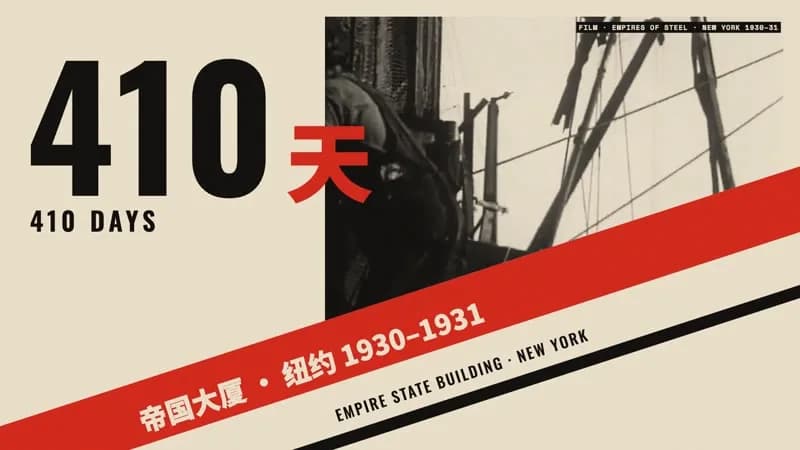
| Title package | a red band slams along the axis; a window cut to the band's edge runs footage; digits stamp one per eighth, the CJK unit in red | S1: window clipped to the band's top edge (onBar), digits measured and slammed individually, reg() registers the group for readcheck |
| Lower third | a red bar from the left edge with Chinese, an ink tab with the English | 92 px bar at y ≈ 760–850, slams in 0.14 s, slides off with the next transition |
| Map + iris | a document map pushes in, a red circle is drawn round the place, the circle opens onto the site | mapXf() (scale / focus / angle over time), mapToScreen() keeps the circle on the map point; aperture = arc clip whose radius grows to the frame |
| Vertical title | CJK characters stacked top to bottom beside a tall window, English rotated 90° | per-character slams 1/16 apart |
| Date on a girder | the date in paper on a red band crossing the footage | text placed on the band's centre line (point + normal offset), rotated by the axis |
| Grid | 3 × 3 windows light one per sixteenth in a spiral, the centre counts 1…9 and lights last in red | cells back()-scale in, each a different clip at 1.4–1.8× speed, ping-pong |
| Split strips | the frame rotated to the axis, three strips of two panels each; one panel changes per beat; strips drift in opposite directions | panels ≤ 1,160 px wide so the film stays ≤ 2.5×; red seam on the middle strip |
| Freeze + annotation | flash, freeze, push; a red ellipse drawn on the object, a leader to a red block with the number; a jump-in; the film keeps running in a small red-framed inset | the circle is computed from the zoom focus so it follows the jump; inset = same clip, live |
| Document close-up | a tilted page slams in, a red marker bar crosses the exact sentence, a red block repeats the number huge | marker in multiply over the scan's own line coordinates; a tall slot beside it runs footage fast to show speed |
| Process staircase | three windows rising along a diagonal, red triangles between them, a counter climbing to the claim | each window 0.75 s apart; the counter is graphic, only its end value is a fact |
| The question | a document heading on an ink ground, circled in red; a huge red "?" | heading cropped tight so only the words that matter show |
| Acceleration + count | full-frame windows tilted ±4–6°, ground alternating red / ink, a four-digit counter jumping per cut | cut list with shrinking durations; the original sound plays alone |
| Multiple exposure | top-down footage, a second clip in screen at 45 %, cut-outs in multiply, the answer in a block |
exposure window ≤ 1,700 px on a red ground |
| Chart from the document | the page turns 90°, its drawings lift off and stand on one ground line to scale, red dimension lines, numbers, names; held; then the verdict block | outlines keyed from the scan, scaled so tip-to-ground = value × px per unit; the winner tinted red (source-in) |
| Photomontage tower (signature) | floors of footage strips slam in from alternate sides every sixteenth, an ink beam under each, a cut-out worker lands on every other; the camera climbs; a crown and a figure on top | FLOORS list, camera y follows the eased count of built floors; the floor counter runs to the dated anchor, rests there while its caption is up, then runs on to the end value |
| Silence beat | ink frame, one red rivet | half a bar; the score and foley are gated to zero |
| Result composition | huge numbers left, a tall slanted window with the finished subject (camera tilts up it), a tilted photo, a red wedge | numbers slam, the last line restamps the key number on red |
7. Sound palette
- Score: an original machine ostinato (eighths, minor, e.g. D–D–F–D–A–D–E–F) in spiccato cellos + staccato bassoon, staccato tuba / trombone on the beat, snare sixteenth taps, xylophone for counts (one rising note per lit cell or built floor), horn / trumpet stabs and a short brass motif, timpani rolls into section changes, gran cassa + gong on the heaviest hit. Sampled CC0 libraries (VSCO 2 CE, VCSL). No piano-and-strings bed.
- Original sound alternates with music: in one section the orchestra stops and a real recording (a rivet gun, a machine, a crowd) carries the cut alone, each burst trimmed to its shot. Bring it in a beat early (J-cut).
- Foley for every printed action: slam = low thump + steel clank; stamp = thump + clack; wipe and iris = whoosh; marker = filtered noise scrub; paper = band-passed rustle; floors and cells = pitched clanks.
- Layers: ambience (a real site / street recording, about 20 dB under the voice, out for the silence), foley ducked 35 % under speech, music ducked 70 % under speech (≈ 10 dB under the voice), narration compressed and levelled by RMS. Master to −14 LUFS with the peaks limited to −1.8 dBFS before
mux.sh, and a 25 ms fade at sample 0 (an AAC encode overshoots on a hit at the first sample). - Narration (when the film has one): short declarative lines, newsreel cadence, never more than one sentence over a format; numbers spelled out for TTS, digits in subtitles.
8. Native moves
- The document is marked, not quoted: the actual sentence on the scan gets a red bar; the number then becomes a red block.
- The document becomes the chart: drawings printed on a page are lifted off, turned and stood on a ground line to scale.
- A + B → idea: two kinds of image alternate faster and faster (the machine / the hands; a heading / the people it leaves out) until a card or a number states what the collision meant.
- Count the many: a counter driven by the cuts, a grid that fills cell by cell, a tower floor by floor.
- People build the structure: cut-out figures stacked into the thing they made (photomontage).
- Silence, then the heaviest hit into the result.
9. Footage
- Ask first. Before searching, ask the user for their own material: film, video, photographs, scans of documents (reports, brochures, letters, minutes), data. What they give leads; archives fill gaps.
- Where to look, and how to judge the licence (
demo/tools/footage.pysearches, downloads and records licence, author and source page intoSOURCES.jsonl;footage.py mdwritesSOURCES.md):- Internet Archive: read each item's
licenseurland description. Public Domain Mark / CC0 / CC BY are usable; no licence field is not. For a pre-1978 US film, check the title and end cards for a copyright notice: published 1930 or earlier = public domain in the US by date; published without notice before 1978 = public domain; with a notice, check renewal. Corroborate date and producer elsewhere (a library catalogue, an archive exhibit). Avoid YouTube mirrors, re-uploads with no provenance, colourised or "restored" versions. - Wikimedia Commons: read the file page's licence and its source institution. Public domain, CC0, CC BY (credit in full) are usable; CC BY-SA is not used in library demos.
- US National Archives (NARA), Library of Congress, NASA, other US federal agencies: federal works are public domain; check each item's rights statement. "No known restrictions" (LOC, Flickr Commons) is not clear enough: name it to the user or find the same image elsewhere with a clear statement.
- Museums with open access (Met, Rijksmuseum, Smithsonian): CC0 where the object page says so; check that the item is still marked open access.
- University and city libraries (e.g. Columbia's digitised ephemera on the Internet Archive): use their rights statement; "copyright status undetermined" is not usable.
- Internet Archive: read each item's
- Tell the user before downloading: what (title, years), from where (URL), under which licence and why. Keep
raw/under about 1.5 GB; download serially (Commons rate-limits). - Record every asset with the seconds used (
footage.py used <name> "<source s> → film s"), list it indemo/CREDITS, and keep the trail for anything judged "no notice". - Footage that is not of the subject itself (another city, another year) may stand in only with a tag that says exactly what it is.
10. Facts
Every number, date and claim on screen or in the voice comes from an official or primary source (a contemporary report, an official brochure, a government record), kept in demo/FACTS.md with the URL and the quoted wording. Counters are graphics: only their end values and dated anchors are facts. Where two primary sources disagree (a film's intertitle vs. the official brochure), use one and record the conflict.
11. Engine
demo/index.html: one Canvas 2D page, statelessrender(t); scene functions draw a full frame; wipes draw the old scene, clip, draw the new one, then the band.txt()draws and registers rotated text boxes forreadcheck.mjs;reg()registers a group drawn in pieces;slam(),flash(),flicker(),shake(),slant()(parallelogram windows),cover()(focus-point cover fit),clipImg()(forward / reverse / ping-pong / speed).demo/tools/prep.py: the print grade, clip extraction to 24 fps JPEG sequences (one percentile set per clip), stills, document pages and outline keying, cut-outs.demo/tools/fonts.py: fetch the OFL fonts and subset Noto Sans SC to the characters used.demo/tools/cues.mjs: subtitle cues from the page's own table, measured one line per language.demo/audio/mix.py: score, foley, narration, ambience, master.- Checks:
readcheck.mjs,asr_check.pyper line,tools/final_asr.pyon the final mix,tools/rhythm_report.py(flat windows, cut points, hit-to-onset alignment),mux.shloudness.
12. Pitfalls of the medium
- Upscaled archive film turns to mush on a 1080p full frame: window it; split strips into panels; keep zooms inside the 2.5× ceiling.
- Per-frame grading pumps: one percentile pair per clip.
- Type on a band running off frame: place it from the band's centre line (point + normal), not by eye.
- Red on red: a red answer block on a red exposure ground disappears; switch it to ink.
- A face as hero: ordinary identifiable workers appear in groups, at work, in quick cuts; no slow motion or close-up protagonist.
- Counters read as facts: label only the end value and dated anchors; a caption beside a counter must match the number shown at every frame (stop the count on the caption's value while it is up).
- A number without a unit: every counter carries its unit in the same layout as elsewhere (小时 / 层 / 人 MEN).
- Ink type over a window: a line that runs past a photo's edge disappears into dark film; give it a paper tab or keep it clear of the window.
- The verdict covering what was compared: place it where no item is, after the hold.
- Too many documents: one marked sentence per document shot; a page with three highlights is a slide.
- Short labels in an acceleration fail reading time by design: keep text out of the 1/8-beat cuts; put the result in a held block after.
- A hit at sample 0 overshoots in the AAC encode: fade the first 25 ms.
13. Variation space
The agent decides per film: structure, which archive and documents, which formats (not all of them in one film), the axis angle (−15° to −30°), the red's exact hue, tempo (100–140 BPM), whether there is narration (intertitles only is valid), the signature build (a tower, a bridge span, a crowd forming a word, a map filling in).
- Three structures: a calendar machine (one counter runs the whole film and stops at milestones); a document that asks and footage that answers (the turn at the middle); one object's journey through a process, then the scale of the whole.
- Subjects that fit: construction and engineering histories, industrial anniversaries, mass events, labour and collective effort, infrastructure openings, any "many people, one machine rhythm" story with archive film and documents behind it.
Our demo: DEMO.md.
补充
示范片
410 Days
本风格的来源项目:开源项目 Lemo-Opuscar(项目仓库)。本站保留原项目署名,具体许可以该项目仓库为准。
分享来源:B 站视频(341 种代码动画风格)