
 L Lemo-Opuscar
玻璃质感产品
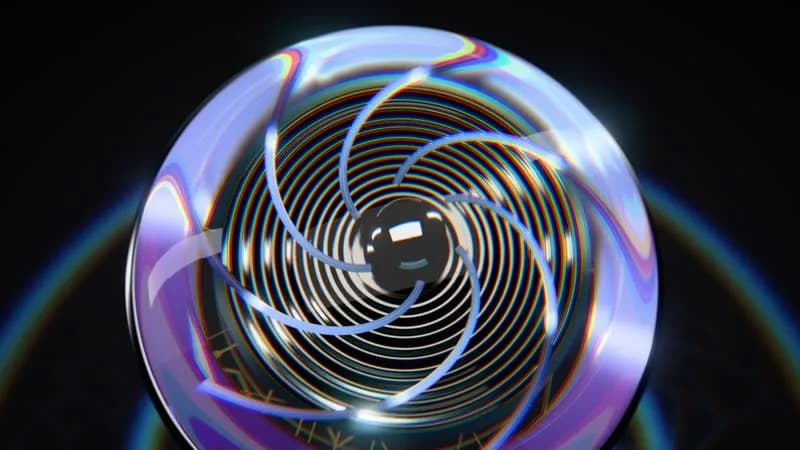
虚构玻璃耳机 Aura 的开箱与特写。
- 适合:
- 高级的产品感
- 系列:
- L Lemo-Opuscar
- 更新:
- 2026-10-29
风格提示词
Glass Product Render — Style Prompt
Launch-film product rendering in transparent and frosted glass: a dark-field studio, strip-light sweeps, dispersion, caustics, light travelling inside the object, slow exploded views that snap shut on a downbeat.
References (grammar only): premium launch films (a sweep drawing a contour in the dark, slow orbits, macro rack focus, cuts on the beat, ultra-thin wide type); transparent-hardware adverts (internals as ornament, exploded views, black and white plus one accent); dark-field glass photography. Copy none of their silhouettes, typefaces, sounds or colour templates, and never name them in the film.
1. Essence, and what it is not
A single hero object of glass, metal and light floating in an infinite black studio. Long strips behind and beside it turn clear glass into a thin white outline with rainbow edges; the internals show through as in a display case. Everything moves slowly and precisely; every cut, sweep and pulse lands on the beat.
The object is always fictional. Never reproduce a real product silhouette (a famous phone or headphone outline), a real brand name, logo, typeface or UI.
Not a white-cyclorama catalogue shot, not a wireframe HUD, not a keynote slide: material and light are the subject.
2. Materials & rendering
- Studio = a strip-light scene, not an HDRI. Photo-studio HDRIs contain windows and clutter that print as messy streaks on glass. Build a tiny black scene of emissive planes and bake it to PMREM every frame (
pmrem.fromScene(env, 0, 1, 1000), dispose the previous RT): tall side strips behind (silhouette), a wide far strip (horizon rim), a soft top box (volume for frosted glass and metal), a weak front card (off when concave glass faces camera), a top-front key only when parts must be read one by one, an accent card driven by the pulses, and the sweep: a tall strip on an arc behind the camera (azimuth = camera + π). Being real geometry, its highlight, refraction and dispersion move physically; never paint a 2D highlight. - Clear glass:
MeshPhysicalMaterial, transmission 1, roughness ≈ 0.015, IOR ≈ 1.5, thickness sets lensing (thicker = stronger), dispersion on (three r163+), near-neutral attenuation,side: DoubleSideso other glass sees its back faces. - Frosted glass: transmission ~0.85, roughness ~0.4, milky tint, thick. On black it reads as dark grey plastic unless something bright is behind or inside it: an opaque emissive shape inside (blurred into a soft internal glow) and/or a bright gradient behind.
- Metals make transparency worth looking at: satin bands, chrome (roughness ≥ ~0.14), brushed surfaces via a roughness map, boards with gold traces. Anything inside transmissive glass must be opaque (only opaque objects reach the transmission buffer).
- Light guides: dark polished opaque acrylic, clearcoat, emissive comet pulses along a UV axis via
onBeforeCompile(Gaussian head, exponential tail, white-hot core, hue drifting with age). Idle emission ≈ 0. - Background: black with an optional dark-grey radial sweep that separates glass edges; the floor fades into it, no horizon line. Floor: black gloss, blurred mirror, radial fade, procedural caustics (lens ring with R/G/B radii offset, warped Voronoi filaments, rings spreading from events).
- Post: 2× supersampling; physical DoF (shallow macro, deep exploded views); bloom only above ~1.1; Neutral tone mapping (AgX washes accents to white); grain 0. Model in mm, near plane 1.
3. Colour logic
- The world is neutral: black, greys, the white of strip reflections, the metals' own tints.
- One accent colour family, reserved for light (emission, caustic rings, the dispersion line on UI), optionally drifting between two neighbouring hues with age or energy. Examples: ice blue → soft violet; amber → rose; green → cyan. Pick it from what the product does, never from a brand.
- Emitters that only illuminate (inside frosted glass) stay cool-white and dim.
- Dispersion rainbows are allowed only at thick glass edges and in the caustic, never as a gradient on surfaces or type.
4. Type & subtitles
- Subtitles are a slab of frosted glass: a centred rounded bar filled with the live frame blurred (
filter: blur() brightness()on the WebGL canvas,preserveDrawingBuffer: true), a little cool white, a thin highlight stroke and an accent line on top. A licence-free grotesk (e.g. Inter Tight), light weight, ~36–44 px, near-white. Hold ≥ max(1.8 s, speech + 0.6 s). - Titles: the same grotesk at an ultra-thin weight (200), very large (100–140 px) with very wide tracking, centred in the upper third; a diagonal glint sweeps across the letters in sync with the sweep light on the object. Small tracked caps (18–20 px) for kickers and credits.
- The product name and slogan are title cards, not subtitle lines.
5. Motion quality
- Everything moves on ones (24 fps), eased: ease-in-out for camera orbits, ease-out for parts decelerating into a float, ease-in for a snap back.
- The camera always drifts: slow orbits or push-ins; never a locked-off frame, never handheld, except a couple of frames of micro-shake on an impact.
- Exploded view: parts spread along the axis (~2× product size), each with a small deterministic tilt and a spin proportional to its offset; long ease-out apart → short drifting hover → very short ease-in snap on a downbeat.
- Objects lift out of cradles tilted toward camera and settle upright; lids hinge at the back and stand behind the object as a backlit halo.
- Light pulses and sweeps are events on the beat grid, not free animation.
6. Camera grammar
A vocabulary, not a route. Opening and ending come from the topic.
| Move | Expresses | Can serve |
|---|---|---|
| Sweep over a dark object, slow push | Contour before content | an unknown thing; a before-state |
| Slow high 3/4 orbit | The whole object in one move | a mechanism opening; variants |
| Macro, rack focus surface → part inside | Nothing to hide | an ingredient; a sensor |
| Side macro orbit | Material contrast | layers; a seam |
| Exploded view, axis ~40° to view, orbit | Technical beauty, suspension | architecture; a pause before a turn |
| Straight-on front, slight push | Declaration | a single number; a name |
| Top-down macro | A pattern at full size | channels; a circuit |
| Top-down on the floor | The effect leaving the object | range; spreading energy |
| Low orbit under the object | Monument, weight | durability; a flagship |
| Slow pull-back into negative space | Room for type | a claim; a question |
Framing: one hero, centred or on a strong diagonal, never cropped by the frame edge in a wide. Cut only on beats (bar lines where possible). Product films need no spatial continuity between shots: each shot is its own presentation stage, so hide or move anything that doesn't serve it. Transitions are cuts on the beat or a sweep passing through black; never dissolves or wipes.
7. Sound palette
- Minimal electronic, never piano-and-strings. Timbres, as options: bowed-glass or wet-finger tones, granular crystal clouds, glass bells and FM glass plucks, a filtered tick grid for precision, a warm pad, sub drone, soft short kicks and claps, 808 bass (sine with pitch envelope, soft saturation, slides), noise and saw risers, a high glass ding. Minor and modal colours suit the dark studio.
- Lock every pulse, sweep and snap to the score: write the cue map first and share one hit list between the score and the renderer; light pulses may follow a syncopated bass pattern exactly.
- Silence as a tool: a short stretch of total silence (reverb tails cut too) before a release, at most a reverse whoosh inside it.
- Foley follows the material: glass shimmer for sweeps (band-passed noise + inharmonic partials, panned with the strip); glass-metal friction for moving covers; magnetic clicks (sub-2 ms transient + 3–5 kHz metal resonances + low thump); air puffs for moving parts; a snap = a cluster of clicks ms apart + an inharmonic glass chord (partials ×2.76, ×5.4); glass-on-glass ticks.
- Voice: restrained, low, launch-like, very few very short lines. Never a product name alone (ASR and viewers mishear it): give it a verb.
- Mix: duck music ~12 dB and foley ~6 dB under the voice; limit the biggest bass peaks ~3 dB so loudnorm stays linear; −14 LUFS; grain 0.
8. Native moves
A menu: use the ones your story needs. Adapting any topic: find the invisible thing the product does and make it visible as light inside glass.
- Transparency. The inside is the hero; rack focus from the shell to the part within. Fits content like: a juicer's blades; a watch movement; a supplement capsule's layers.
- Lensing. A thick glass dome magnifies and bends what is behind it; macro through it feels like looking into a jewel. Fits content like: a camera module; a magnifying tool; a water filter.
- Dispersion. A sweep crossing a thick edge becomes a moving spectrum. Fits content like: a prism lamp; a display's colour range; a skincare bottle.
- Light that travels inside. Energy (charge, data, heat, sound) runs as light through channels. Fits content like: a battery filling; a router's data threads; a kettle heating.
- Caustics. An internal pulse becomes a ring spreading over the floor. Fits content like: a speaker's range; a perfume's trail; a wireless charger's field.
- Exploded view and snap. Parts float apart and snap back on a downbeat. Fits content like: a modular backpack; a pen's refill system; a repairable phone.
- Frost to clear. A frosted shell clears (roughness and tint animate to zero) and the inside appears. Fits content like: a privacy feature; a fridge's contents; an honest price breakdown.
9. Pitfalls of the medium
- A manually updated mirror uses last frame's camera → call
scene.updateMatrixWorld(); camera.updateMatrixWorld()first; the transmission pre-pass re-renders it → no-op itsonBeforeRender, update once per frame. - A coloured emitter inside frosted glass tints the whole object; idle glow under a lens dome becomes a pale blob; AgX turns accents white; frosted glass on black is black; mirror chrome becomes a white disc → the rules in §2–§3.
- An exploded view seen perpendicular to its axis is edge-on lines → axis ~40° to camera.
- Pure profiles read as simple shapes (mushrooms, pot lids) → 3/4 views, lids upright behind.
- Bass peaks without headroom push loudnorm into dynamic mode → limit them in the mix.
- Concave glass facing camera prints the front card as a grey rectangle → card off.
10. Engine
In demo/: studio.js (strip env baked per frame, sweep, background, floor mirror + caustics + rings), product.js (glass / frosted / metal / guide materials, comet-pulse shader, explode()), main.js (staging, cameras, frosted subtitle bar, title glint), story.js (beat-grid timeline shared with the score), music/score.py, mix.py (foley + voice + ducking). New object: replace the geometry in product.js (e.g. a glass cylinder with a coiled light guide), keep materials and studio.js.
11. Variation space
You decide the object (always fictional), internals, accent, structure, opening, ending, camera path, pacing and music. All far from our demo:
- Structures: a line-up (three variants compared by what glows inside); a day in light (one object through morning, noon and night, the strip kit rotating around it); material stack (one layer removed per beat until the core stands alone).
- Openings: inside first (one internal part; the shell forms around it); caustic first (light on the floor, followed up to the object); silhouettes (several dark outlines; one begins to glow).
- Endings: floor only (the object leaves, its caustic keeps pulsing); cool down (emission fades to bare strip outlines); held macro (no pull-back; one detail, the name small).
How our demo was made (story, shots, score, end card, build): DEMO.md. Read it after your treatment exists.
补充
示范片
Aura — Hear the Light
本风格的来源项目:开源项目 Lemo-Opuscar(项目仓库)。本站保留原项目署名,具体许可以该项目仓库为准。
分享来源:B 站视频(341 种代码动画风格)