
 L Lemo-Opuscar
微游戏快闪
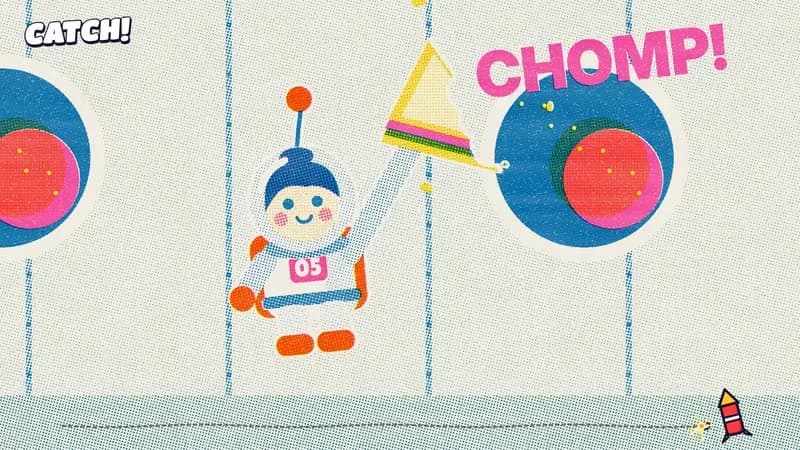
见习宇航员闯五秒训练营,越来越快,Boss 关亲手降落回地球。
- 适合:
- 快节奏,一连串小场景
- 系列:
- L Lemo-Opuscar
- 更新:
- 2026-10-29
风格提示词
Microgame Frenzy — Style Prompt
A rapid-fire party-game film: one command word, a few seconds, one action. Every microgame is drawn in a completely different art style, and the film keeps getting faster.
Genre reference (grammar only): the WarioWare series. Never use its name, characters, UI, microgames or music.
The format suits short films; once the frenzy stops building, end it.
1. Essence, and what it is not
- A microgame = a shouted command word + 2.5–4 s + one action + one result (success, or a funny failure).
- Each microgame uses a different visual medium (crayon, ink wash, terminal, risograph, pixel, blueprint, Swiss type, clay, cut paper, woodcut…). The jolt of each switch is both the joke and the beat.
- One fixed home look holds the film together: a show stage with a host, a lives counter and a stage number, which the film returns to between games.
- It keeps accelerating: every few games tempo, game length, dwell, command hold and animation frame rate step up together.
- The hero survives every medium by keeping two or three silhouette marks.
Not Game Show Flat (one art style, rounds of bars, call-and-response), not a style sampler reel (every game has stakes; lives connect them), not a montage (each game has a rule grasped in under a second).
2. Materials & rendering
- Home stage: flat toon, thick near-black outline (~7 px), flat fills, one hard-edged shadow (fill in the shade colour, clip to the shape, refill shifted up-left). Fixed furniture: a frame-within-the-frame where games play (a TV, an arcade cabinet, a phone, a window), the lives board, a stage badge, a trigger prop (button, lever, bell).
- Each medium is a simplified re-drawing, 100–200 lines of code, built around one channel trick that makes it read at a glance:
- drawn media store pressure or wetness in a channel (crayon: alpha = pressure against paper tooth; ink: wet and dry ink channels);
- print media store plate densities (riso: a channel per plate, additive overprint, halftone, misregistration);
- screen media are low-res buffers scaled up (pixel: indexed buffer, auto outline, dither; terminal: hand-authored glyph art, phosphor shader);
- technical media are line systems (blueprint: line weights and dimensions; Swiss: a strict grid, one sans, one signal colour).
- Hero translation: the hero is redrawn from scratch in each medium, but the same marks always survive (e.g. a hat shape, one coloured dot, a number on the chest). Make a model sheet of the hero in every medium before animating.
- Mixed-media frames: alpha-coverage media over a base, paper media multiplied, screen media flat and clipped to a panel. WebGL2 material shaders turn the channel buffers into each look.
3. Colour logic
- The home stage owns a saturated party palette: a deep ground behind a rotating sunburst, two or three loud accents, plus a fixed success colour and a fixed fail colour used by stamps and the lives board only.
- Each medium brings its own palette from its tradition (wax colours, one-ink-plus-vermilion, amber phosphor, three riso plates, a limited pixel palette, white-on-blue, black-white-red). Never tint a medium with the home palette.
- One accent follows the hero across media where the medium allows (a single vermilion dot in ink, an inverse glyph in a terminal, a signal-red circle in Swiss type): it is how the eye finds the hero after a switch.
- Example home palettes: violet
#2a0f5cwith magenta#ff2e88, gold#ffc928, cyan#1fd1d1; teal ground with coral and lemon; black stage with hot orange and electric blue.
4. Type & subtitles
- The command word is the subtitle: a heavy display face (e.g. Titan One), white with a thick ink outline, a coloured drop and a burst behind it, skewed a few degrees. It slams in over ~3 frames (overshoot → settle), holds, then shrinks into a corner tag before the first action, so the result is never covered. One-off banners fly out instead of tagging, so tags never pile up.
- Other lines: a rounded card in the home palette with the home outline and hard shadow, a friendly rounded face (e.g. Lilita One ~50 px), a small speaker icon; placed above the timer in games. Hold ≥ max(1.8 s, speech + 0.6 s), never under a big banner.
- Inside a game, any text (replay captions, labels) uses that medium's own typography.
- The command word appears in the .srt only, never burned twice.
5. Motion quality
- The frame rate is part of the ladder: characters step on twos or at 8 fps early, faster later, on ones at the climax. Camera moves, transitions and the timer spark always run on ones.
- Five things accelerate together at each speed-up: tempo, game length, stage dwell, command hold, character frame rate.
- The timer is visible and on the beat: e.g. a fuse with one knot per beat, the spark passing each knot exactly on it. It freezes in a replay.
- Unified transition through the frame-within-the-frame: push into the screen to start a game (~0.25 s), shrink the game back into it to return (~0.33 s) with a ✓ / ✗ stamp. No fades, no blank frames.
- Failure is performed: the action overshoots, splats, bonks or rolls off; the medium's own physics makes the joke.
- Instant replay for a failure that must be understood: freeze, half speed, push-in, letterbox, a caption in the medium's type.
- The home host has a tick on every beat; stopping it dead is the strongest emotional tool.
6. Camera grammar
A vocabulary, not a route. Opening and ending come from the topic.
| Move | What it expresses | Can serve |
|---|---|---|
| Start inside a game, command already slamming | the rules explain themselves | throwing the viewer in |
| Pull back out of the game screen | scale: this was one screen on a show | the first return to the stage |
| Locked frontal home frame | the constant; only the scoreboard changes | stage beats; the host's reaction |
| Slot reels (the stage splits into spinning strips of earlier frames, stopping one per beat) | acceleration, a summary | a speed-up; a change of round |
| Extreme insert on the trigger prop | the start, felt | a game starting on the downbeat |
| Lights cut to one top spot, frame unchanged | stakes; the last chance | the last life; a decision |
| Tile flip (last frames of past games flip into pieces of a new frame) | the past becomes the material of the present | a boss or finale; a recap |
| Push into a detail, hold | the viewer notices before the hero does | a clue; a silence |
| Snap back to wide on one beat | release | a solution blooming; a save |
| Split screen, two media side by side | comparison, rivalry | two players; before/after; two approaches |
Framing: the game screen is a fixed fraction of the frame (around 40 % of the width); in a mixed-media frame keep one focal chain (A leads to B leads to C) and push info panels into a corner.
7. Sound palette
- Music first: a tempo grid and a cue table before any animation; every picture hit lands on a listed cue.
- A constant groove + one colour instrument per medium. The groove (kit with ghost notes, slap or synth bass, brass stabs, keys) runs throughout; each medium adds its own timbre: toy piano for crayon, shakuhachi or guqin for ink, square beeps for terminals, vibes for print, pulse arpeggios for pixel, a typewriter for drafting, claves for Swiss, kalimba for clay, koto for woodcut.
- Foley follows the medium: wax squeaks, wet splats, teletype relays, paper crunch, bit-crushed noise, ratchets and stamps, hollow bonks. Home stage: a spring trigger click, glass crack for a lost life, card flips, a reel whirr, sparse claps.
- Acceleration options (use what fits): a rising brass run into each speed-up; the key rising a step per round; halving note values instead of changing tempo; dropping the groove to a heartbeat on the last life.
- Real silences: at least one before the biggest hit (a heartbeat or one pitched note may remain). The loudest moment comes right after the longest silence.
- Voices: a host who shouts every command a hair after the stab so brass doesn't mask it; a hero with very few words (reactions work best). Duck music ~11 dB and foley ~6 dB under voice. −14 LUFS.
8. Native moves
A menu: use the ones your story needs.
- Style switch per game. Each task is drawn in the medium that suits it. Fits content like: the steps of baking bread (flour in crayon, oven dial in blueprint, crust in woodcut); a day of a nurse; a heist's roles.
- Command word. One verb is script, subtitle and downbeat. Fits content like: SCAN! at a checkout; BREATHE! in a yoga class; SIGN! at a contract signing.
- Lives as UI. The counter carries emotion without narration; 3 → 2 → 1 (blinking) builds tension alone. Fits content like: a phone battery; retries on a driving test; chances left on a quiz.
- SPEED UP. Everything steps up together. Fits content like: rush hour; the last week before a deadline; a kitchen during dinner service.
- Failure becomes the solution. The material of an earlier failure returns in the final game as the answer. Fits content like: a spilled coffee that later stains the winning map; a bug that becomes a feature; a missed train that leads to the right meeting.
- Boss mixes the rules. The final game is built from pieces of earlier media. Fits content like: a final exam; launch day; a festival's closing night.
- Instant replay. The joke explained in slow motion. Fits content like: a goal-line decision; a typo that shipped; a cat's leap that missed.
9. Pitfalls of the medium
- A luminance-ramp ASCII figure is mush → hand-authored glyph art with structural glyphs, an inverse glyph for the accent.
- Ink shapes read as smoke unless their silhouette is designed (a short round blot phase, then a clear structure with seams and light edges).
- A failure at high tempo goes unread → make the action overshoot and hit something, or give it an instant replay.
- Alpha-coverage media show the background through gaps → a full-pressure base where it must be solid.
- Drawing helpers with a global context draw on the wrong canvas when scenes render into offscreen buffers (game screen, reels, tiles) → set and restore the context.
- Command tags pile up → secondary commands fly out.
- A 100 % white flash reads as a blank frame → cap at ~60 %.
- TTS single-word commands gain a vowel tail ("Pump!" → "Pompey") → generate a two-word phrase and cut after the first word using ASR timestamps; verify each clip, since ASR mishears 0.2 s words in a dense mix.
10. Engine
demo/timeline.js (tempo grid and segments, the single source of truth), demo/toon.js + demo/stage.js + demo/hud.js (home look, stage, timer, command word, stamps, lives, subtitle cards; call setCtx when drawing offscreen), demo/chars.js (host and hero rigs), demo/glpass.js (WebGL2 material shaders: riso, crayon, CRT, ink, blueprint paper), one demo/g_<medium>.js per medium (sceneX(g, lt) + the hero translation), demo/film.js (transitions through the TV, slot reels, tiles, events). Module map and build: DEMO.md.
11. Variation space
You decide the tasks, which medium draws each, the home stage and its frame-within-the-frame, the host and hero, the number of rounds, where failures fall, the finale, the opening and the ending. The command → action → result unit, the medium switch and the acceleration stay.
All far from our demo:
- Structures: two players, alternating (each game is played by one of two rivals; the lives board is a tug-of-war); one day, hour by hour (each game is an hour, the speed-ups are the morning rush and the evening rush, the finale is midnight); a relay (the result of each game is the object handed into the next one, so the chain is the story).
- Openings: the home stage asleep (lights off, the host wakes on the first beat); a game-over screen we rewind from; the lives board alone, a counter clicking down before we know what it counts.
- Endings: a high-score table where the hero types their name letter by letter in each medium; the credits as one more microgame (CATCH THE NAMES!); the home stage packs away into the frame-within-the-frame and the screen switches off.
How our demo was made (story, shots, score, end card, build): DEMO.md. Read it after your treatment exists.
补充
示范片
Five-Second Astronaut
本风格的来源项目:开源项目 Lemo-Opuscar(项目仓库)。本站保留原项目署名,具体许可以该项目仓库为准。
分享来源:B 站视频(341 种代码动画风格)