
 L Lemo-Opuscar
80 年代赛璐璐动画
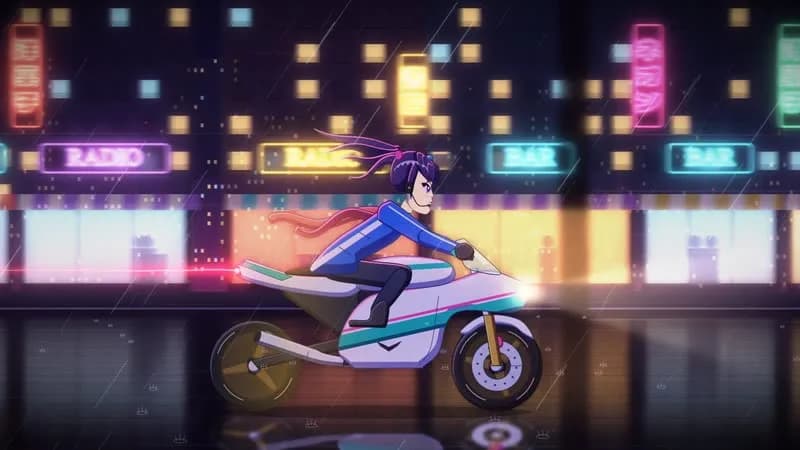
快递少女骑车穿过雨后霓虹都市,赶在黎明发射前送到一盘磁带。
- 适合:
- 霓虹城市、怀旧
- 系列:
- L Lemo-Opuscar
- 更新:
- 2026-10-29
风格提示词
80s Cel Anime — Style Prompt
Hand-painted cel animation from the golden age of Japanese OVAs, re-created in code: flat two-tone cels over airbrushed backgrounds, backlit neon, limited-animation timing, played back as a late-80s videotape on a CRT television.
References (grammar only): 1980s Japanese OVA and TV cel animation in general (painted-background vs flat-cel contrast, backlit light, held drawings, speed grammar, city-pop openings). Borrow the era's craft, never a specific work's characters, mecha, logos, place names or signature shots.
1. Essence, and what it is not
Four layers, and the contrast between them is the look:
- Background painting: soft airbrushed gradients, glowing windows, wet reflections; painted once at load (colour + emissive pair), then only slid.
- Cel (characters, vehicles, props): flat fills, hard-edged shadow and highlight shapes, coloured outlines, never pure black; stepped at 12 or 8 fps.
- Light: backlit cel (透過光): signs, lamps, title letters glowing through the frame; flares, halation.
- Playback: videotape on a CRT: chroma bleed, scanlines, grille, phosphor glow, darkened corners, faint noise.
If a frame looks like modern digital anime, one layer is missing. Not moe anime (round eyes, giant irises, hatched blush), not vector clip-art (uniform black lines, gradients in shapes), not a film-print pastiche (no gate weave or scratches: this is tape).
2. Materials & rendering
Cel rendering. Fill, then a hard shadow crescent, then a hard highlight crescent, then the coloured outline. No gradients inside a cel shape (exception: one "harmony" painted still at a peak). Automatic shading: clip to the shape and fill shape − shape shifted toward the light with the shadow colour (even-odd); the same shifted away for the highlight and for a saturated neon rim light (2–4 px). Add hand-placed cast shadows. Outlines ~2–3 px at 1080p, scaled down (0.45–0.8×) in extreme close-ups. Colour models per lighting (色指定): define each character in daylight, derive other sets by multiplying lit / shadow / line separately, plus a backlit silhouette set with a warm rim.
People the 80s way. Construct the head (sphere + jaw): long egg-shaped face, soft-point chin, far eye foreshortened with a cheekbone turn in 3/4. Almond eyes near the vertical middle of the head, a thick upper lash line flicking outward, a tall oval layered iris, two highlights, long thin brows. Nose = a shadow plane + one stroke; one faint blush layer, never hatched. Hair in overlapping locks with sharp uneven tips over a wider dark under-layer, a continuous "angel ring" highlight with a zigzag lower edge. Lines: skin thin warm dark brown, hair dark purple; only hard props near-black. Emotion lives in brows, lid height, iris size, mouth corners and shoulders. Build and approve a model sheet first; draw every shot from the same head function.
Backgrounds. Painted once at load: sky gradients, airbrushed clouds with lit undersides, buildings or landscape with painted light sources, and always a matching emissive plate that slides with the colour plate. Wet ground = a flipped, blurred, streaked copy of the plate darkened with ripple bands. Generic sign words only, never brands. Moving plates get a light horizontal smear (~16 px) against strobing.
Light and lens. Bloom strongly from the emissive canvas, weakly from the colour canvas above ~0.9; tint the widest bloom red-orange (halation). Flares: star-burst, anamorphic streak, hexagonal ghosts through frame centre. Stamp every cel's silhouette in black onto the emissive canvas so glow never bleeds through it.
Videotape + CRT, restrained and deterministic: chroma bleed (sharp luma, horizontally blurred and slightly shifted chroma), fine scanlines anchored to output pixels whose gap shrinks on brights, a faint RGB grille, phosphor glow, darkened corners without curved borders, faint signal noise. Subtitles are composited inside the pass after grading. Two optional accents: a power-on (dot → line → picture) and tracking noise (a few frames of tearing, rolling band, vertical hop). Check moiré on a 720p downscale. Frame: full 16:9 as a theatrical feature (4:3 pillarbox is valid for an OVA feel).
3. Colour logic
- Painted plates carry gradients and atmosphere; cels are flat, few-colour, saturated. Each time of day gets its own colour model, never a filter over the frame.
- The protagonist has one accent colour that pops in every lighting set. Line colours are dark versions of their fill.
- Skin gets its own colour in every set; multiplying daylight skin by a tint turns faces pink under neon.
- Examples: night city (indigo, violet, neon magenta, cyan, window gold); seaside noon (cobalt, white cumulus, sand, coral); classroom dusk (amber, chalk green, brown wood, purple shadows).
4. Type & subtitles
- Subtitles live on the tape, composited inside the CRT pass: a semi-condensed sans (e.g. Barlow Semi Condensed 600, ~50–56 px), cream-yellow with a thick dark outline and soft shadow, ~96 px above the bottom; a second speaker may take a second colour and a small boxed tag. Hold ≥ max(1.8 s, speech + 0.6 s); a line yields to the next.
- Titles: heavy italic Latin in a chrome gradient (sky → white horizon line → violet → pink → gold), dark + neon outlines, optional katakana line (e.g. Dela Gothic One), glowing through the emissive layer, flickering on at 12 fps with a light sweep and a star glint.
5. Motion quality
- Characters on twos (12 fps); performance beats (blinks, eye openings, lip flaps, gestures) on threes (8 fps). Camera, light sweeps, flares and rain on ones (24 fps); a stepped camera judders.
- Cycles: hair and cloth as ribbons driven by a travelling sine, 4-drawing cycle (6 when calm); bounce = a 12 fps jitter of a few px.
- Move light, not drawings: coloured bands sweeping across a held cel (
source-atop). - Impact frames: 2 frames of an inverted or monochrome silhouette over radial lines, then the result.
- Hold the peak: a painted still with a slow pan, only cycles moving.
- Fast blinks (one 8 fps closed drawing); eye openings in three drawings; lip flaps of 3–4 shapes at 8 fps ending on a held expression.
6. Camera grammar
A vocabulary, not a route. Opening and ending come from the topic.
| Move | What it expresses | Can serve |
|---|---|---|
| Multiplane crane over a tall plate | a world revealed layer by layer | arriving; descending into a place; rising above it |
| Side tracking, 3–4 parallax layers | steady momentum | a journey; a chase; progress |
| Rear view into a pseudo-3D canyon | speed, pressure ahead | a race; a tunnel; a countdown |
| Held bust with light bands | speed or tension without animation | a drive; waiting; a decision |
| Insert with bokeh and a sliding highlight | this object matters | a letter; a key; a ticket |
| Extreme close-up on eyes | resolve, recognition | a choice; a promise |
| Slow pan across a painted still | awe, a held breath | a peak; a memory; a landscape |
| Radial speed lines + one-beat freeze | the instant before impact | a leap; a collision; a goal |
| Truck-in through a window or screen | entering another world | a flashback; a broadcast; a dream |
| Locked two-shot with lip flaps | conversation | banter; a confession; an argument |
| An earlier composition repainted | what changed | after a storm; years later |
Cut on bars. Framing: cels readable against the painted plate; keep the lower ~120 px clear for subtitles. Transitions: cuts, white flashes, impact frames, tracking noise at a tape-related beat; no digital dissolves or wipes.
7. Sound palette
- Instruments (city pop, synth funk, anime-opening pop): saxophone or synth-brass lead, FM electric piano with a bell transient, slap bass, chorus-y 16th guitar chanks, gated-reverb snare and big toms, drum machine, arpeggiated analog synth, string pad, FM bell sparkle. Extended jazz-pop harmony (maj7, 9ths).
- Techniques, as options: band-pass the score to cassette/AM when a diegetic source plays, then open it; a brass hit on a title; a drum fill left open for an effect; one beat of true silence before a peak; a semitone lift for a last chorus.
- Foley (synthesized): engines from an RPM curve, rain, tire hiss, wind, bells, radio squelch, impacts, sparks, cassette clicks, crowd murmur, door buzzers, footsteps on wet pavement; tape accents get their own thunk, whine, hiss.
- Voice: an English-dub feel, short lines; a second voice through a phone/radio band-pass (~380–2800 Hz). Verify every line with whisper.
- Mix: limit then compress TTS, voices ~10 dB over ducked music (duck ~9 dB), beds ducked ~3 dB, choruses louder than intros, two-pass loudnorm to −14 LUFS.
8. Native moves
A menu: use the ones your story needs.
- Small flat hero in a huge painted world. Fits content like: a first day in a big company; a child in a museum hall; a lone researcher at an observatory.
- Stillness as drama (held close-up or harmony still). Fits content like: an exam result; a goodbye at a gate; an unveiling.
- Backlit light. Fits content like: a lantern festival; a screen full of code; a lighthouse; stage lights.
- Speed grammar (speed lines, looping plates, impact frames). Fits content like: a sprint final; a data packet crossing the world; a kitchen rush.
- Light-band sweep on a held cel. Fits content like: a night train; a scanner reading a page; a heartbeat quickening.
- A song as an object (tape, radio, jukebox changes the score). Fits content like: a band's origin; a family memory; a call-in show.
- Tape artefacts as punctuation. Fits content like: found home video; a rewind to the past; an interrupted broadcast.
- Colour-model change (one place, another hour). Fits content like: a day in a shop; a farm's seasons; before/after a renovation.
9. Pitfalls of the medium
- White cels bloom pink → bloom from the emissive canvas; weak, high-threshold bloom on colour.
- Neon bleeds through characters → silhouettes stamped into the emissive canvas.
- Black holes in highlights → clamp before S-curves.
- Thick rim light swallows thin shapes → 2–4 px offsets.
- Hair like tentacles, a face like a paper mask, moe eyes, uniform black lines → the drawing rules in §2.
- Pink faces under coloured light → skin gets its own colour per set; weaker light sweeps on faces.
- Front views are the hardest drawing → hide them behind a visor, a windscreen or backlight when you can.
- Pseudo-3D points behind the camera flip into the sky → clamp z to the near plane.
- Canvas silently falls back to a serif →
document.fonts.loadevery weight before painting. - CRT detail inflates files → noise in the shader, only
noise=c0s=2:allf=tin ffmpeg, CRF ≈ 23; loudnorm in two passes withlinear=true; don't let a limiter flatten the dynamics.
10. Engine
In demo/: cel.js (path, cel, ribbon, flutter), pal.js (colour models), head80.js (80s head, 3 views × expressions), hands.js, bg.js (painted plates, crane plates, wet reflections), fx.js (rain, speed lines, flares, trails), post.js (WebGL tape + CRT pass: bloom, grade, subtitles, power-on, tracking noise), hud.js, music/score.py (numpy FM/slap/brass synthesis), tools/. ?test=model|close|side draws model sheets, ?raw=1 skips the CRT pass. A minimal new use: a harbour sunset plate with its emissive pair, one cel boat shaded with cel.js, through post.js.
11. Variation space
You decide the structure, the characters, the world, the opening, the ending, the camera path, the pacing and the colour models. All far from our demo:
- Structures: slice of life in four seasons (one place, four colour models, a small change each time); two-hander dialogue (a locked two-shot comedy that breaks into one fantasy sequence); the mock opening credits (a character roster introduced one by one, each with a pose and a name card).
- Openings: in the middle of a conversation (lip flaps already moving, no establishing shot); a TV being switched on to an in-world broadcast; a close-up of a drawing hand in a classroom, then cut to the world it draws.
- Endings: a freeze-frame on a laugh with a "to be continued" card; the tape runs out into blue screen; a slow pan up to a starry sky from a quiet rooftop, no dialogue.
How our demo was made (story, shots, score, end card, build): DEMO.md. Read it after your treatment exists.
补充
示范片
City Lights, 1987
本风格的来源项目:开源项目 Lemo-Opuscar(项目仓库)。本站保留原项目署名,具体许可以该项目仓库为准。
分享来源:B 站视频(341 种代码动画风格)