
 L Lemo-Opuscar
彩色玻璃窗
阳光从清晨移到黄昏,照到哪一格花窗,哪一格的故事就动起来。
- 适合:
- 光、庄重
- 系列:
- L Lemo-Opuscar
- 更新:
- 2026-10-29
风格提示词
Stained Glass — Style Prompt
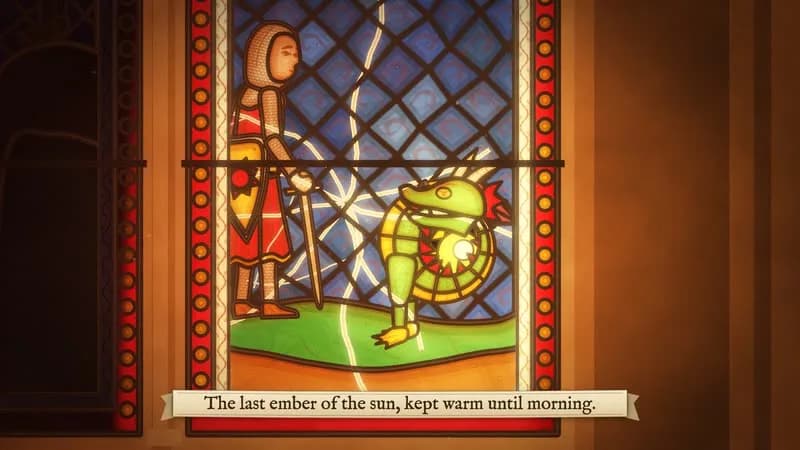
A medieval stained-glass window seen from inside a dark stone hall, alive only where the sun touches it: light is the clock, the camera and the story.
References (grammar only): the window prologue of Beauty and the Beast (1991) (chapters pane by pane, a storyteller's pace); the glass knight of Young Sherlock Holmes (1985) (glass that cracks and recombines piece by piece); 12th–13th-century Chartres glass (colour logic, grisaille, leading). Copy none of their characters, compositions, subjects or music.
1. Essence, and what it is not
- Cut pieces of coloured glass in dark lead cames, faces and folds painted in brown grisaille.
- Glass has no light of its own: it glows only when the sun is behind it and throws a soft coloured copy onto the stone floor; unlit, it is dark and milky.
- Figures move piece by piece, rigid and stepped.
- The room is always there: stone, a splayed embrasure, iron saddle bars, a floor that catches light.
- Secular: no crosses, saints, halos or other religious imagery; borrow the craft, not the subjects.
Not vector art with black outlines, not a kaleidoscope or Voronoi filter, not Tiffany Art Nouveau, not mosaic (mosaic reflects; glass transmits).
2. Materials & rendering
One formula for everything (a WebGL compositor), so every element sits in the same light:
glass   = tonemap( backlight(x,y,time) × transmittance × glass texture ) + weathering haze × room light
surface = albedo × (room ambient + glow spilled from lit panes + point lights)          // stone, lead, iron
floor   = flagstones × (ambient + projected colour-patch map, blurred + halo)            // perspective or top-down
+ additive light shafts with dust · bloom (bright glass eats into the lead: the "irradiation" effect)
- Hue-preserving tone mapping: per-channel
1-exp(-x)turns cobalt pastel; blend to per-channel only at the very top so a sun disc burns white while blue stays jewel blue. - Unlit panes: weak sky light + room-lit weathering haze, figures ghostly but readable. Lit panes: backlight ~2–3×, a soft, slightly skewed moving band edge.
- Pieces: smooth Catmull-Rom cuts (no deep concave corners). Every piece is textured (
multiplyin its clip): streaks at a per-piece angle, hue drift (±10 %), darker aged edges by the lead, ±9 % thickness variation. The shader adds seed bubbles, scratches and thickness clouds in world space; fade small features below ~0.6× zoom or they sparkle. - Lead: near-black, one planar network, thinner on small pieces, round joins, faint grey flange, solder blobs; only where colours meet (one colour = one piece).
- Grisaille: tapered trace lines in translucent dark brown; matting (stippled wash, graded shade, soft band inside the lead); scraped highlights (a thin stroke beside each fold in the piece's own colour: the only highlight transmitted light allows). Patterns (mail, scales, plates) are grisaille arcs and bands.
- Faces: almond eyes, heavy upper lid, big pupils, brow flowing into the nose. Expression lives in brows and mouth; change it by swapping the face piece, never morphing.
- Backgrounds: hand-cut lozenge quarries (jittered lattice, shared vertices, a painted motif each); borders of a coloured band with pearls and a white fillet with a running vine.
- Room: warm grey ashlar, a lighter embrasure, mullions; floor of large irregular flagstones, never the wall's running bond.
- Floor projection: blurred, ~20 % desaturated, modulated by the stone, haloed, mirrored (the window's top lands farthest into the room). Shafts: additive with dust, near 0 at the window, peaking ~40 % down.
3. Colour logic
- Two hues carry the picture (one deep, one hot); three or four more only as small touches. Example (Chartres logic): cobalt ground, ruby, touches of gold, green, murrey.
- Greenish white glass sparingly (faces, fillets, sky). Flesh darker than you think, or backlit faces burn white.
- A story light (candle, lamp, screen) may take a colour no glass uses, so it reads as a source.
- The sun's colour is the clock: blue-white dawn, near-white brightest noon, gold afternoon, deep orange dusk (raise intensity rather than redness), weak blue moonlight. Patch length follows sun height.
- Stone and lead take colour only from spilled or projected light.
4. Type & subtitles
- Subtitles: a parchment banderole near the bottom (curled ends, gentle sag, thin rule), IM Fell English ~44 px in dark ink. It unfurls from the centre; text fades in only once it is ≥ 75 % open; pad the ribbon well past the text. Hold ≥ max(1.8 s, speech + 0.6 s).
- Titles: incised Roman capitals (Cinzel 600) in the stone, dark cut, light lower lip, gilding, revealed by a moving band of light; small lines ≥ 30 px on screen. In the glass, text only as grisaille on a white-glass scroll.
5. Motion quality
- Figures step at 8 fps; light, camera, shafts and dust move on ones (24 fps): stepped light reads as flicker.
- Rigid pieces on 2D FK (
setTransform(base · T(part)), free draw order); long bodies are spine chains of banded pieces. - Freeze rule: a pane's figures use
min(t, t_lightLeft). Actions land on the beat. - Crack: jagged lines race from the impact in ~¼ s, bright with light, a short white flash and a 2-frame shake.
- Re-leading: piece groups slide one beat each with a small outward bump along the lead, each ending in a weld spark; cracks become mending leads.
- Glass never bends or morphs; things appear by being lit, not faded in.
6. Camera grammar
A vocabulary, not a route. Opening and ending come from the topic.
| Move | Expresses | Can serve |
|---|---|---|
| Truck sideways with the band of light | Time passing, the story moving on | a sequence of steps; a day; chapters |
| Locked close-up on one pane | This panel is "now" | a line being read; a character's decision; a detail |
| Pull back to the whole window | The rule, or the whole story at once | learning the system; a summary; aftermath |
| Tilt down the shafts to the floor, then top-down | The picture leaves the glass and becomes light | an event too big for its frame; a dream; a memory |
| Hold through a crack, no cut | The event is the medium breaking | a turning point; a loss; a revelation |
| Slow push toward a small light | Attention narrowing to one source | a discovery; a secret; hope |
| Tilt up to a rose or tracery | Something above the panels governs them | a clock; a cycle; an overview |
| Rack between two panes, one lit, one dark | Past and present side by side | before/after; two lives; cause and effect |
| Low angle along the embrasure, glass raking | The window as architecture, scale | awe; an institution; a long history |
| Return to an earlier framing under new light | The rhyme shows what changed | growth; nightfall; repair |
Framing: subjects big (close-ups ~1.3–2.3× a lancet width); in a narrow lancet stack figures diagonally; a revealed thing near centre, ≥ ~1/8 frame width with glow. Transitions: moving light, shafts, a crack, darkness; never a dissolve, wipe or flip.
7. Sound palette
- Instruments: organ (pedal drone, soft stops, full), harp, hand chimes, tubular bells, recorder or a chant-like voice, water-glass notes, timpani; also hurdy-gurdy drone, psaltery, portative organ. No generic piano or strings.
- Mode families: church modes (Dorian, Mixolydian, Aeolian, Lydian), open fifths, drones, parallel organum.
- Options: free unmetred chant for darkness; one note meaning "the light" each time a pane wakes; an organ pedal that holds and then cuts out; a rising scale, one step per lit piece.
- Foley, material first (synthesizable): struck glass = inharmonic partials ~1 : 2.32 : 4.25 : 6.63 : 9.38; crack = snap + pane thump + rain of tinkles; lead = stick-slip creak; glass sliding in a came = gritty band noise + faint squeal; solder = hiss + tick; air on light moves; stone-hall ambience; birds in the vault; iron ticking as it cools.
- Silence: a hard stop, reverb tails included, only the glass's own ring or creak inside; a single long-reverb bell can close it.
- Mix: big and reverberant; heavy hits avoid word onsets; music ducked ~9 dB under voice; −14 LUFS. Voice: a gentle, even storyteller, few short lines.
8. Native moves
A menu: use the ones your story needs.
- Light is time, and the camera. Only the lit pane is alive; figures freeze when the light leaves. Fits content like: the steps of a recipe; a factory's shifts; four seasons of one farm.
- Glass projects onto stone. A key scene plays in the floor patch, which stretches as the sun sinks. Fits content like: a memory seen larger than life; a sports play replayed as shadows; a data trend drawn by lengthening light.
- Glass cracks, lead mends. Pieces slide along the leads into a new picture, leaving scars. Fits content like: a company's reinvention; an injury and recovery; an old building restored.
- A window holds its own light. At night one pane glows from a source inside the story. Fits content like: a lighthouse keeper; a night-shift nurse; a server that never sleeps.
- The window as a diagram. Lancets as columns, a rose as a wheel or dial, the border as a timeline. Fits content like: a product lineup; the parts of a cycle; a family tree.
9. Pitfalls of the medium
- Hidden leads show through front pieces → erase the surface under each piece before stroking its lead.
- Pastel glass → hue-preserving tone mapping; darker flesh. Red dusk × blue glass = mud → keep blue alive, raise intensity.
- Voronoi reads as a filter; flat fills read as clip-art → hand-cut lozenges, texture on every piece, heavy grisaille.
- A sharp floor patch looks like a decal → blur, desaturate, stone-modulate, halo. Shafts at full strength at the window wash out the pane.
- Top-down projection is flipped → put the wall at the frame bottom so figures stand upright (mirrored, correct).
- Patch-map canvas size mismatched with the code draws into a corner of the texture → one constant size.
- Carved text in a dark wide is unreadable → push in, park a light on it.
10. Engine
In demo/: glass.js (pieces, textures, lead, grisaille, lozenges), comp.js (WebGL2 compositor), window.js (lancets, rose, borders, wall, carving), scene.js (camera, floor projection, shafts, dust), subs.js (banderole), test.js / frames.js (model sheets and style frames from the real engine), music/score.py, mix.py (glass/lead foley). knight.js / dragon.js show the rigid-piece FK rig pattern; build your own subjects with it.
11. Variation space
You decide the window (lancets, a rose, a medallion, a clerestory), the subjects, the order of light, opening, ending, camera path and pacing. All far from our demo:
- Structures: a rose window as a dial (petals lit in turn like hours, the centre the answer); one tall lancet read bottom to top (a tilt up a life or a process, medallion by medallion); two windows facing each other (the sun lights one side in the morning, the other in the evening; the floor between them holds their meeting).
- Openings: the floor first (only a coloured patch on stone; tilt up to find its source); a lit window from outside at night (a figure passes a glowing pane, then we are inside); the glazier's bench (a single piece cut and leaded, becoming the first piece of the picture).
- Endings: clouds cover the sun (every pane fades to grey at once; one line lingers); a new pane leaded in (an empty lancet filled with the last scene); the camera leaves through the door (the window small behind, its patch still on the floor).
How our demo was made (story, shots, score, end card, build): DEMO.md. Read it after your treatment exists.
补充
示范片
The Dragon of the East Window
本风格的来源项目:开源项目 Lemo-Opuscar(项目仓库)。本站保留原项目署名,具体许可以该项目仓库为准。
分享来源:B 站视频(341 种代码动画风格)