
 L Lemo-Opuscar
蓝图 / 工程制图
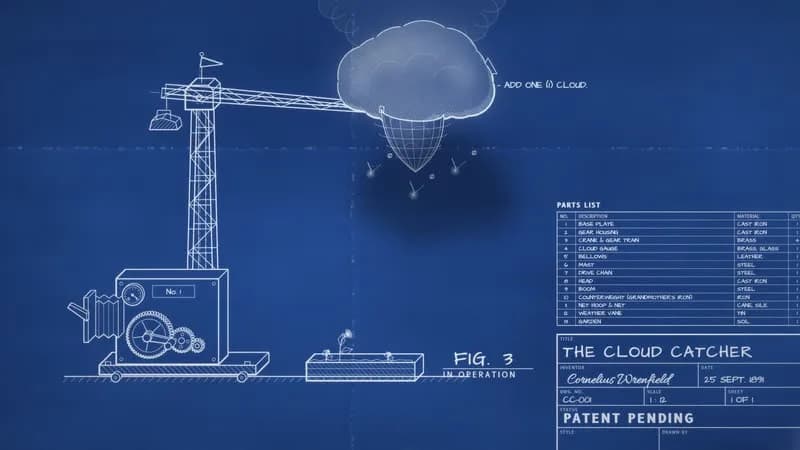
发明家的蓝图自己画出一台接云机器,修订云线变成了真的雨云。
- 适合:
- 讲原理、讲结构
- 系列:
- L Lemo-Opuscar
- 更新:
- 2026-10-29
风格提示词
Blueprint — Style Prompt
Engineering drawings that come alive on a sheet of cyanotype paper: white technical line work on Prussian blue, drawn in drafting order, with annotations that move.
References (grammar only, never copy): the moving technical drawings in Prologue Films' Iron Man (2008) end credits, Leonardo's Codex Atlanticus pages, 19th-century US patent drawings (Fig. 1 / Fig. 2, part balloons, fine-line shading), the automaton drawings in Hugo (2011). No Marvel elements, no real patents, no real inventor's machine or signature.
Suits films of 30–60 s.
1. Essence, and what it is not
- The whole film happens on one sheet of blueprint paper lying on a dark drafting table. The camera moves over it like an eye reading a drawing.
- White line work on uneven Prussian blue: centre lines, outlines, hatching, dimension lines, leader lines with numbered balloons, a title block, a notes column.
- A 2D line-drawing language: orthographic and oblique/isometric projection are allowed, 3D rendering never.
- Rigorous convention carries the tone: the drawing is dry and exact; the notes can carry wit, warmth or gravity.
- The designed thing is the character. A machine, object, building or plan acts through its parts; people appear only as a hand shadow with a pen, or a signature.
Not Hologram HUD (no glowing wireframe, no 3D orbit), not Whiteboard (no marker on white), not Copperplate Engraving (no burin tonal hatching as the whole look).
2. Materials & rendering
- Sheet: procedural cyanotype in a shader in sheet coordinates, crisp at any zoom: fbm between two Prussian blues, coating streaks, fibres, fold creases (bright edge, dark edge, whitening), bleached edges, specks. Around it: dark drafting cloth with a drop shadow.
- Lines: pale blue-white, slightly soft (mipmap bleed), a faint ink breakup driven by paper grain. Four weights (outline, detail, thin, hair; e.g. 3.2 / 2.0 / 1.25 / 0.9 sheet units). Screen width = sheet width × zoom^0.65, so close-ups don't turn into sausages and wides don't vanish.
- Dash conventions: centre line (long-short), hidden (short dashes), phantom / cutting plane (long-short-short), scaled with zoom so the pattern stays on the paper.
- Occlusion by painter's order: every solid is filled with "paper" before its outline is stroked. Oblique extrusion: stroke the outline at N depth steps at 2× width, then fill the same steps with paper; a clean silhouette survives.
- Composite in buffers: ink (white = exposed line); fx (shadow, wetness, stamp ink as channels); a subtitle overlay last. Shadows darken lines too: that is how a lifted object proves it has left the paper.
- Hatching (fine-line shading) for sections, soil, weights, at 45°, spacing 8–14 units.
- Cyanotype and water: a drop blooms deeper blue with a pale tide line; white lines inside the stain go soft; ink signatures bleed.
- The one real thing (optional, at most once): a drawing symbol that leaves the drawing language gets soft volume, one gradient across its whole shape, glow, and a shadow falling across the lines. It leaves a pale unexposed imprint where it was drawn.
3. Colour logic
- Blue and white only. The blue varies in value (coating, stains, folds); the white varies in weight and softness, never in hue.
- One non-blue colour, used exactly once: a rubber-stamp ink (red is classic; a green APPROVED or black VOID work too). It carries the verdict.
- The "real" object at the climax may carry light (white glow, soft value), not a new hue.
- Example blues:
#18336B→#2A58A6with lines#E7F0F9and table#0D1116; a faded sun-bleached sheet#3A6DA8→#5B8CC4; a deep over-exposed sheet#0F2350→#1D3F80.
4. Type & subtitles
- Hand lettering for header, labels, notes and subtitles (e.g. Architects Daughter); a technical sans for title-block fields (e.g. B612); a script only for the signature (e.g. Allura). All OFL.
- Text is written on left to right with a glowing nib, like everything else.
- Subtitles are drawing notes: a light translucent box with double white rules, a "NOTE / n" cell, the text lettered on in ~0.35 s, a small leader tick. Placed per shot in empty sky, never fixed to the bottom (the bottom of a drawing is ground line, base and title block). Wrap at ~880 px. Hold ≥ max(1.8 s, speech + 0.6 s).
- Every subtitle is also lettered into the sheet's GENERAL NOTES column, so the final wide shows the whole voiceover as drawing notes.
- The title is the sheet header; the title block holds status and verdict fields.
5. Motion quality
- Camera and draw-on on ones (24 fps). Continuous moves within a section, hard cuts on downbeats between sections; tiny camera bumps only for physical impacts (paper slap, stamp).
- Draw-on truncated by arc length with a glowing nib at the head; items staggered within a layer; each layer starts on a beat.
- Drafting order: centre lines → outlines → detail → hatching → dimensions → balloons → labels.
- Exploded views: parts leave in sequence on subdivisions of the beat, eased, and return one per beat-group with a click.
- Mechanisms step on the grid like an escapement: a gear advances one tooth per subdivision with a short ease-out; meshing phases computed so teeth really interlock; chains move with their sprockets.
- Machine acting: angles, droops, volumes and gauge needles are the face. Failure = slowing, sagging, winding down over ~1.5 s; joy = snapping upright, a needle overshooting (back-ease).
6. Camera grammar
A vocabulary, not a route. Opening and ending come from the topic.
| Move | What it expresses | Can serve |
|---|---|---|
| Whole sheet on the table | scale, the document as an object | establishing; a verdict; a series of sheets |
| Medium on a figure, subject ~80 % of height, sky on one side | the design being drawn | drafting; explaining a part |
| Track along a path of force (chain, pipe, wire, beam) | cause and effect | how it works; a sequence of operations |
| 2× close-up cut on a downbeat | the mechanism's heart | gears meshing; a valve; a joint |
| Locked-off, hold a beat | deliberation | a hand revising; a decision |
| Oblique depth factor 0 → 0.5 | the flat drawing "turns" and gains thickness | from plan to object; a reveal of depth |
| Section line sweeping across | inside vs outside | a cutaway; hidden structure |
| Lateral pan across Fig. 1 → Fig. 2 → Fig. 3 | versions, steps, time | revisions; stages of construction |
| Slow push-in, no voice | wonder | the one real thing |
Keep storytelling shots close; full-sheet wides are rare. Keep the main figure at least 960/zoom from any sheet edge you will frame. Transitions: cuts on downbeats, or fig-number rewrites on the sheet; no dissolves.
7. Sound palette
- Contrapuntal, mechanical music: harpsichord, bassoon, strings spiccato, harp, celesta, music box, clavichord, a small wind ensemble. Imitative lines (an invention, a canon, a fugato) feel like interlocking parts; a short repeated motive can be the "gear".
- Foley follows materials. Paper: roll crackle and slap, T-square wood slide, technical pen scratch (2–6 kHz grain, length = stroke length), lettering bursts, compass squeak, hatching strokes, eraser rub, tracing-paper rustle. Brass and wood: part clicks (resonances ~3–5 kHz), escapement ticks, chain rattle, spring twang, wind-down ticks that slow geometrically. Water: soft damped pats per drop, a light rain bed. Rubber stamp thump, pen cap click.
- Options for the arc (in any order, use what the story needs): instruments dropping out with a written-out ritardando into true silence; a single questioning figure alone; a suspended chord held without resolution under the magic; a full cadence on the stamp; the theme in augmentation for a close; adding a section per mechanism that joins.
- Silence may contain paper sounds only.
- Voice: dry, understated, reading design notes, a few short lines. Leave the most emotional moment voiceless.
- Mix: music ducks well under voice (~0.36 ×), foley by half; whooshes low-passed so they don't mask consonants. −14 LUFS. Little added grain (the paper already has it).
8. Native moves
A menu: use the ones your story needs.
- Drafting order. The object draws itself as an engineer would, a layer per beat. Fits content like: a bridge; a violin; a kitchen renovation.
- Live annotations. Dimensions measure moving parts and the numbers change; balloons fly with parts; a section line reveals the inside. Fits content like: a heart valve; a folding bicycle; a rocket stage separating.
- Fig. numbers as transitions. "FIG. 1" struck through and rewritten "FIG. 2 · EXPLODED VIEW". Fits content like: versions of a product; phases of a construction; a recipe's stages.
- Projection as camera. The oblique factor animates; exploded parts fly along the depth axis. Fits content like: a floor plan becoming a building; a circuit board; flat-pack furniture.
- A symbol made real (once, if at all). A convention leaves the drawing language: a dimension arrow flies, a hatch becomes rain, a centre line becomes a road, a weld symbol sparks. Fits content like: an invention finally working; a city plan becoming a street; a dream becoming a plan.
- Cyanotype and water. Drops bloom and soften lines. Fits content like: a flood-defence design; grief; a harbour wall.
- The title block as story. Status field = the verdict; revision rows = history. Fits content like: a rejected permit; REV. 1–5 of a city; an approval after years.
9. Pitfalls of the medium
- Main figure near the sheet edge → wides show the desk. Keep margins or enlarge the sheet.
- Upward explosions hit the header → explode sideways and flatten long parts during the explode.
- Subtitles on the ink buffer vanish off-sheet and can't occlude lines → separate overlay, premultiplied alpha.
- An object darkened by its own shadow → zero the shadow channel only in its area.
- Per-lobe shading on a blobby shape reads as grapes → one gradient across the union; crescents from a union-minus-shifted mask; fill unions as one path (
nonzero) or overlapping fills make bubbles. - A small payoff undersells the return → the payoff object ~⅓ of frame height, centred, drawn stroke by stroke, subtitles off it.
- Line weights not scaled with zoom → sausages in close-ups, vanishing wides.
10. Engine
demo/paper.js (WebGL2 compositor: procedural cyanotype, ink bleed, wet stains, shadows, stamp, roll), demo/draw.js (drafting engine: camera, oblique projection, draw-on polylines, solids with paper fill, hatching, dimensions, balloons, text), demo/sheet.js (border, header, title block, parts list, notes, revision cloud, rain, hand shadow, stamp), demo/film.js (timeline on a beat grid: cameras, acting, subtitles, sound events). A new machine goes in its own module like demo/machine.js. File map and build: DEMO.md.
11. Variation space
You decide what is designed, its figures, the flaw or turn (if any), the voice, the one real thing (or none), the camera path, the opening, the ending and the length.
All far from our demo:
- Structures: a city through revisions (one site plan, REV. 1 to REV. 6, each revision a decade, the title block filling with dates); two sheets, one table (two designs drawn in parallel that turn out to fit together); a teardown in reverse (the sheet starts full and parts are erased one by one until only the centre line of the idea remains).
- Openings: a single centre line crossing an empty sheet on the first beat; the stamp first (REJECTED lands, then we see what was rejected); tracing paper lifted off a finished drawing to reveal a blank sheet underneath.
- Endings: the sheet folds up along its creases into a pocket-sized square; a coffee ring lands on the title block and the tide line becomes the last circle of the design; the lights go off and the white lines glow faintly on the dark sheet.
How our demo was made (story, shots, score, end card, build): DEMO.md. Read it after your treatment exists.
补充
示范片
Patent Pending: The Cloud Catcher
本风格的来源项目:开源项目 Lemo-Opuscar(项目仓库)。本站保留原项目署名,具体许可以该项目仓库为准。
分享来源:B 站视频(341 种代码动画风格)