
 L Lemo-Opuscar
油画厚涂
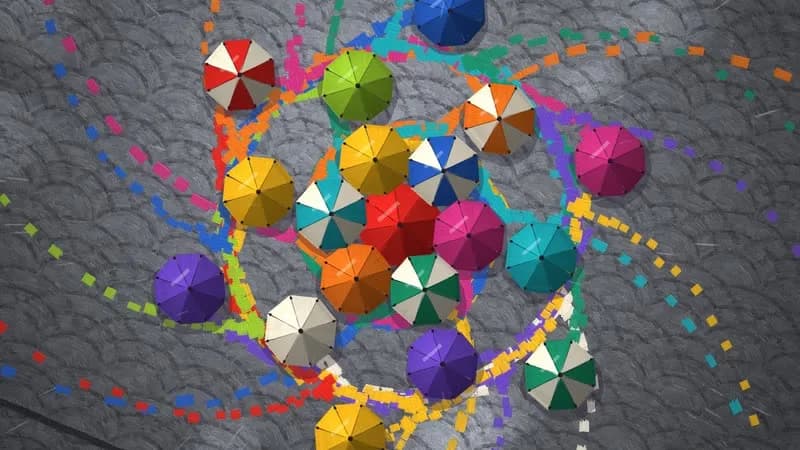
灰色雨中广场,第一把红伞撑开,圆舞曲把整个广场刷上颜色。
- 适合:
- 浓烈的情绪
- 系列:
- L Lemo-Opuscar
- 更新:
- 2026-10-29
风格提示词
Impasto · Palette Knife — Style Prompt
Thick oil paint laid with a palette knife: big, flat, sharp-edged planes of colour, raked by light so every ridge of paint shows. Clarity first: value structure before texture, hard edges at the focus, calm planes everywhere else.
References (grammar only): the opening titles of The Umbrellas of Cherbourg (1964) (overhead choreography read as moving colour); palette-knife street paintings (Leonid Afremov and the genre around him) (knife mosaic, vertical wet reflections, warm lights against cool shadow); Sorolla / Sargent (few, decisive strokes and strong light); Edgar Wright's music-locked editing (one action, one sound, one cut). Never copy their images, compositions, melodies or characters, and never name them in the film.
1. Essence, and what it is not
A moving oil painting made of knife strokes. Each stroke is a real object: a slanted plane of paint with a ridge where the blade pressed, a lip where it lifted off, broken streaks where the paint ran out, two colours dragged into each other. The world is repainted from its strokes every frame, but static paint never moves: only things that move in the story move. Light rakes across a height field, so the paint has body.
The look is clear and graphic (readable like a children's book at thumbnail size) but has the tactile surface of impasto at 100 % crop.
Not a Van Gogh swirl filter (strokes boiling everywhere), not a brush texture over flat vector art, not watercolour (paint is opaque), not a "painterly" photo filter (strokes are designed, not sampled from noise).
2. Materials & rendering
- Value first. Design each set as a flat, value-planned illustration (3 values minimum), then convert it to strokes. If the reference doesn't read at 480 px wide, no brushwork will save it.
- Stroke sizes by importance and depth. Coarse to fine: large planes in sky and walls, a few px only at edges and faces (per shape:
maxR,detail,dir). - Strokes never cross shape groups, so silhouettes stay crisp. Lost edges are opt-in (put two shapes in the same
group). - Thin underpainting (the reference itself, blurred ~1.5 px) under the strokes, so the canvas never peeks through as outlines.
- Knife stroke: longer than wide (≈ 1.7–3.1 × radius long, 0.95–1.45 × radius wide), slanted ends, small angle and value jitter (≈ ±13°, ±6 %). Solid objects that must read as silhouettes (figures, props) get little or no ragged run-out.
- Light rakes over a height field; wet or glossy surfaces get slightly more specular.
- Reflections (wet ground, glass, water) are explicit stacks of short horizontal knife dabs under each light source, broken and fading; never a painted rectangle.
- Render supersampled (2×). No film grain: grain plus compression eats the knife edges.
3. Colour logic
- Planes of mixed, slightly broken colour; each stroke may drag a second colour (
c2) into the first. No gradients made by blending pixels: gradients are made by stroke-to-stroke steps. - Warm light against cool shadow is the default temperature structure; the brightest, purest chroma is reserved for the story's subject (a prop, a crowd, a light source), not the background.
- Colour can be an event. Every stroke can hold a grey and a colour version; a monochrome world with one coloured exception, or a world re-laid from grey to colour, is native to the medium. The grey version is the luminance of the same strokes, slightly cool, with a small colour residue.
- Examples of palettes that fit: an after-rain sunset (cobalt → peach → gold sky, ochre facades, full-chroma props); a harvest field (straw yellow, burnt sienna earth, one viridian tractor); a night kitchen (umber shadows, sodium-lamp orange, one cold blue window). Choose from the topic.
4. Type & subtitles
- Titles are laid in with the knife (a stroke-by-stroke
appearsweep of about a second) and can be taken off by the world (washed by rain, scraped, painted over). They move with the world. - Small text (credits, data, captions) stays crisp DOM text over the painting: knife strokes can't carry small letters.
- A serif display face (e.g. Cormorant, OFL). Subtitles, if there is a voice: plain serif, ≤ 2 lines, in a calm plane; hold ≥ max(1.8 s, speech + 0.6 s).
5. Motion quality
- Static paint is static. Only the things the story moves move (weather, figures, props, ribbons, light). Smooth 24 fps, no stepping: clarity is the brief.
- Moving figures are procedural strokes rebuilt each frame from fixed seeds, so their paint doesn't boil (walk cycles, IK arms, props that open and close).
- Actions sit on the music grid: a change of direction, a pop, a swell lands on a beat.
- Anticipation → action → follow-through on every gesture (lift before the strike, dip before the snap, swing after the stop).
6. Camera grammar
A vocabulary, not a route. Opening and ending come from the topic.
| Move | What it expresses | Can serve |
|---|---|---|
| Slow truck + push on a wide | a world observed; patience | a place; a routine; a crowd |
| Push-in through a silence | inner pressure | a doubt; a decision; giving up |
| Tilt-up from the ground or a reflection | discovery from below | a small character entering; a first sight |
| Pull-back from a close-up | reaction; the world answering | consequence; a reveal of who is watching |
| Rotating crane-out, overhead | pattern emerging from many | choreography; traffic; a gathering |
| Same wide, repeated | before/after | change of colour, season or time |
| Locked frame, light moves | time and weather as the actor | a day passing; a storm arriving |
| Macro slide along the paint surface | the matter itself | a texture; a crafted object; a map |
| Whip-pan into a new painted plate | energy, a jump | a list; montage; travel |
Framing: keep the camera inside the painted plate (half = W/2/zoom), or the canvas shows. The subject gets the hard edges and the smallest strokes; everything else stays in big calm planes. Transitions: paint-over sweeps and scrapes, hard cuts on beats; no dissolves (two layers of knife ridges turn to mud).
7. Sound palette
- Foley follows the paint and the world: palette-knife scrapes on every repaint or paint-over, wet dabs, the materials of the scene (wet stone, nylon, wood, fabric, glass).
- Beds in layers (a hiss, near grains, one distinct detail), filtered when the camera goes under cover.
- Acoustic instruments with a hand-made grain: solo strings, accordion, pizzicato, harp arpeggios, glockenspiel or celesta for pops, piano, guitar, woodwinds; a solo instrument for a lonely world, an ensemble for a shared one.
- Options: one action = one sound = one cut (music-locked edit); pops pitched as a rising arpeggio so a sequence of events climbs; an unresolved phrase that the film resolves later; a hard silence that cuts music and beds to digital zero, containing at most one sound; a J-cut of the next scene's foley into a silence.
- Mix: music and ambience duck under any voice (~8 dB); −14 LUFS. Music and foley can carry a film without narration.
8. Native moves
A menu: use the ones your story needs.
- Colour re-laid by the knife. Every stroke keeps a grey and a colour version; a reveal wave re-paints them stroke by stroke (
reveal,revC). Fits content like: a town waking up; a patient recovering; a brand relaunch; a season turning. - The one coloured thing. The world drawn with
grey: 1, one object withgrey: 0. Fits content like: one person in a crowd; the fruit that ripened; a warning light. - Motion paints the picture. Moving objects drip their colour as knife dabs; seen from above, their paths leave a painted pattern. Fits content like: a dance; delivery routes across a city; a football play; migration.
- Raking light. At the peak, drop the light to a grazing angle so every ridge catches it, then let it settle. Fits content like: a sunrise; a moment of recognition; unveiling a sculpture.
- Paint-over transition. The next shot's strokes are laid over the previous one in a sweep (
appear), with a scrape on the soundtrack. Fits content like: a renovation; memory replacing the present; a timeline of versions. - Sound made visible. A note or a voice becomes a paint ribbon that carries colour to what it touches. Fits content like: a song reaching listeners; a radio broadcast; a rumour spreading.
9. Pitfalls of the medium
- Confined strokes shrink near edges and leave canvas-coloured outlines → add the underpainting texture.
- Draw order in the reference matters: painting the ground after the buildings covers their feet.
- Plain rectangles read as posts or blocks → give silhouettes taper, a lit edge, and one or two defining dabs (shoulder, hair, handle).
- Proportions carry the object's identity at this stroke size: a prop drawn too wide reads as a different thing. Check silhouettes at thumbnail size.
- Film grain or heavy compression destroys the knife edges → no grain, supersample, high bitrate.
- Strokes that are re-seeded every frame boil → fixed seeds per stroke.
- Engine-level WebGL traps (reserved words, VAO binding) are listed in DEMO.md build notes.
10. Engine
Files: demo/engine/impasto.js (renderer), demo/engine/plate.js (reference → strokes).
Main calls: new Impasto(canvas,{W,H,ss}), E.begin() / E.finish(post) (raking light + grade), E.batch() → E.draw(batch,o) for static plates (cam, grey, reveal, appear), E.drawNow() for moving strokes, E.under() for the underpainting, new Strokes().push({...}) (KNIFE, BRUSH, DAB, LINE), new Ref() + paintRef() (reference illustration → coarse-to-fine strokes confined to shape groups), strokePath(). Full parameter table: DEMO.md "Engine reference".
Minimal example: a warm-orange four-point sparkle with a short cursor tail, in knife paint.
import { Impasto, Strokes, KNIFE, DAB, hex } from './engine/impasto.js';
const E = new Impasto(canvas), s = new Strokes(), c = hex('#D97757');
for (let k = 0; k < 4; k++) {                                   // four tapered knife points
  const a = k * Math.PI / 2;
  s.push({ x: 960 + Math.cos(a) * 60, y: 540 + Math.sin(a) * 60, ang: a, len: 120, wid: 46, c, c2: hex('#f0a07a'), type: KNIFE, taper: .95, seed: k });
}
s.push({ x: 960, y: 540, len: 40, wid: 40, c: hex('#f6c0a0'), type: DAB, seed: 9 });   // bright core
s.push({ x: 1060, y: 610, ang: .6, len: 90, wid: 16, c, type: KNIFE, alpha: .8, seed: 10 });   // cursor tail
E.begin(); E.drawNow(s.data(), { grey: 0, run: 0 }); E.finish();
"Only one colour" (monochrome with one exception): draw the world with grey: 1, reveal: 1e6, draw the exception with grey: 0.
11. Variation space
You decide the structure, the cast (or none), the sets, the opening, the ending, the camera path, the pacing, whether there is a voice, and where colour lives. All far from our demo:
- Structures: one object, many hands (a bowl or a boat passes through the people who make and use it, one painted plate per hand); a still life comes alive (a locked table whose objects move in turn, the light crossing it hour by hour); a portrait in layers (a face painted coarse to fine as a voice tells one life, each layer a decade).
- Openings: the bare canvas (underpainting only; the first knife stroke is the first event); macro on a ridge of paint that pulls back to become a mountain or a roof; mid-action (a figure already running across a finished plate).
- Endings: scraped back (the knife takes the painting off to the underpainting, leaving one mark); the light goes out (raking light sinks until only the ridges glow, then black); the frame in a room (the film was a painting hanging somewhere, seen by someone).
How our demo was made (story, shots, score, end card, build): DEMO.md. Read it after your treatment exists.
补充
示范片
The Colour of Rain
本风格的来源项目:开源项目 Lemo-Opuscar(项目仓库)。本站保留原项目署名,具体许可以该项目仓库为准。
分享来源:B 站视频(341 种代码动画风格)