
 L Lemo-Opuscar
字幕新闻
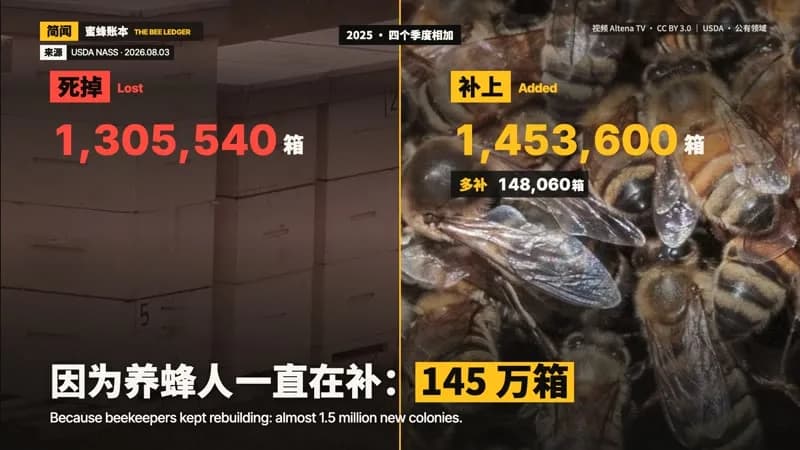
美国一年死掉 130 万箱蜜蜂,总数却涨了 6%:静音也能看懂的新闻。
- 适合:
- 不开声音也能看懂,适合竖屏版
- 系列:
- L Lemo-Opuscar
- 更新:
- 2026-10-29
风格提示词
Caption News — Style Prompt
Social-video news that reads with the sound off. Real footage, photos and the source document are the ground; huge captions are the lead actor, slammed in a chunk at a time with one keyword on a yellow block. Hard cuts on a music grid, numbers that roll, a source tag that slides in whenever a figure appears, and the original document highlighted on screen before its number is believed. 16:9, built for a feed.
References (grammar only): the captions-first social news of the mid-2010s (NowThis, AJ+), horizontal explainers that set big type over footage (Bloomberg Quicktake). Never copy their logos, fonts, colour ratios, idents or shots, and never name them in the film.
1. Essence, and what it is not
- Sound-off first. Every beat must be understood from the picture and the captions alone; the voice adds pace, not information.
- The caption is the shot. One Chinese line, set huge, slammed in two or three chunks, one keyword in a yellow block; one English line under it. The footage is chosen to sit under the line.
- Evidence on screen. Each number arrives with its source: a source tag slides in; key figures are first seen highlighted in the original document; per-shot footage credits sit in the corner like a news "Video:" tag.
- A hook on frame 4. The film's largest number lands in the first 0.15 s and rolls to its value.
- One turn. The bad-news hook is answered by a fact that changes its meaning; the rest of the film explains that turn, one new fact per shot.
Not Data Storytelling (charts are short inserts between footage, never the whole film, never a dashboard). Not a TV news package (no anchor, no lower-third ticker, no studio, no scrolling crawl). Not a keynote: no headers, no centred title-and-bullets, no page turns.
2. Frame and layout (1920×1080)
| Zone | Position | Content |
|---|---|---|
| Footage | full bleed | video, photo, document or data card; never a vertical frame pillar-boxed in the middle |
| Caption card | left aligned at x 120; Chinese baseline y ≈ 948, English baseline y ≈ 1014 | one line per language, never wrapped |
| Channel bug | top left, x 96 y 52, 46 px high | yellow block with a fictional channel name + topic in Chinese and English small caps |
| Source tag | under the bug, y 108, 36 px | white "来源" + dark label (USDA NASS · 2026.08.03, … · 第 13 页); only on data and document shots, slides in 0.2 s |
| Footage credit | top right, 19 px on a 50 % dark chip | 视频 作者 · CC BY 3.0; every CC BY shot carries it |
| Lower third | x 120, y 742, 96 px high | yellow bar + label + one English line; for a place, date or speaker, never for the main sentence |
Under the caption: a bottom gradient (0 → 84 % from y 560) plus a soft dark radial from the bottom-left corner; a top gradient (55 % → 0 over 200 px) under the bug and the credit. Data cards use a lighter gradient that starts at y 820. Graphics and charts sit right of centre and bleed to the frame edge; their title and source sit top left, never centred.
Vertical 9:16 is a different layout, not a crop: put the caption under a 1080×1560 footage band (horizontal sources then scale ≤ 1.5×), stack the chunks on two lines there (the one-line rule is for 16:9 subtitles), and move the bug and source tag into the top safe area.
3. Editing grammar
- Cuts on a 120 BPM half-beat grid (every cut at a multiple of 0.5 s). Footage shots 1.5–3 s; data cards and documents 3–4.5 s; a shot that holds a comparison stays until every item has been fully on screen ≥ 2.5 s.
- Captions cross cuts. A caption can run over two shots (picture changes, words don't); captions change at most every ~2.5 s even when shots change every 1.5 s. Reading time, not shot length, sets the caption clock.
- The order of a fact: footage (feeling) → the number on a card → the document line that says it → the consequence. Never a number without its source tag in the same shot.
- Transitions are few and fixed: hard cut (default); a 1–2-frame white flash on the turn and on the freeze; a card sliding in from the right with speed streaks (0.18 s); a split screen opening from its divider; grid panels rising staggered (0.1 s apart); a punch-in (0.3 s ease-out to ~1.25×) on the culprit; a mask transition where a photo grows out of a map shape. No dissolves, no page turns, no 3D flips.
- Pace: a strong action within 0.5 s of every shot; no frame flat for more than 1 s (rolling counters, line drawing, highlighter sweeps, slow pushes keep it alive); one held breath (2–3 s) after the turn; two real silences.
4. Caption card (the subtitle is the graphic)
- Chinese line: Noto Sans SC 900, 88 px (verdict lines 110 px), ivory
#F7F5EF, 20 px dark soft shadow. Split into 2–3 chunks with|in the timeline; each chunk slams 0.12 s after the previous: scale 1.3 → 1 in 0.13 s (back ease, overshoot 1.6), opacity full in 0.04 s. - Keyword:
{…}inside a chunk; a honey-yellow block#FFC21Awipes left → right in 0.12 s behind it, text turns ink#0E0E0C. One keyword per caption, at most. - English line: Inter Tight 500, 33 px, ivory, fades and rises 10 px in 0.18 s, 0.1 s after the first chunk. It is the spoken line (numbers as digits), not a translation of the Chinese.
- One line per language, always. If either language would wrap, split the sentence into two captions. A caption is on screen ≥ 1.8 s and ideally ≥ the spoken line + 0.6 s; the Chinese is a paraphrase short enough to read in that time (≤ ~14 characters).
- The
.srtis generated from the same timeline (timeline.json→tools/cues.py→core/render/srt.py): one Chinese line, one English line per cue. - A text-only beat (caption with no voice) is native to the style: use it for the breath after the turn.
5. Graphics
- Ledger card (the data-card ground):
#151512sheet, faint ruled lines every 54 px (4.5 % white), a thin red double margin at x 78/86 — the "account book" that ties every chart together. It slides in from the right over 0.18 s; inside, a slow push (×1.025–1.03 over the shot). - Colour meaning: honey
#FFC21A= the point / gains / the highlight; red#FF4A3D= losses, the spike, the bad number; ivory = everything else; grey#8D8B83= labels and units;#5E5C55= the bars that don't matter. - Numbers: Inter Tight 800 with fixed-width digit cells (
num()indemo/main.js), so a rolling counter never jitters. Counters roll with ease-out and turn their colour when they arrive. Units in Chinese (箱, 万箱) set smaller after the number. - Charts: titled top left in Chinese (Noto Sans SC 900 64 px, ≤ 6 characters so it can be read in the shot) with one grey English line; lines draw segment by segment (eio); the key point gets a bigger dot, an expanding ring (0.7 s) and a block label; bars grow from the left one after another (first one slower and longer if it is the point).
- Map: state shapes from Natural Earth, projected (Albers), sequential fill in five steps of one hue, states without data in dark grey with a "未单列" legend swatch; the subject state outlined in yellow with a leader and a label; the map pushes in on it.
- Documents: the PDF page rendered at 220 dpi as white paper on a dark desk (±1–2° tilt, soft shadow, vignette), pushed in slowly; highlighter rectangles placed from
pdftotext -bboxcoordinates (1 pt = 3.0556 px),multiplyblend, swept left → right in 0.3–0.5 s; the number read from it is re-set as a big yellow block beside the page. The printed text is picture; what must be read is re-set in type. - Split screen: two halves with a 4 px yellow divider that drops first; the "bad" half desaturated, darkened and tinted red, the "good" half in full grade; a label block (Chinese + English word) and a counter in each; a shared stamp centred on the divider.
- Grid: three panels (632 px, 12 px gaps) rising staggered; each one lights up (yellow border, label turns yellow) on the word that names it; numbered 1–2–3.
- Freeze frame: the shot stops on a frame, a 0.14 s white flash, punch 1.0 → 1.12, saturation drops to 45 %, yellow corner brackets close in on the subject, a timecode chip with a pause mark appears top right.
- Title sting: a yellow ruled page (the ledger again, in yellow) wipes across the left 45 % over live footage; the title slams, the English title and a dateline chip follow; the page wipes off left and the title becomes the channel bug.
6. Grade and image quality
- One grade for every piece of footage:
contrast(1.07) saturate(0.92) brightness(0.98)+ a 6 % warm soft-light layer; documents 4 %. Light grain in the master (mux.sh … 30 1). - Scale limits: modern footage ≤ 1.5× (prepare frames at their final size with ffmpeg: crop, lanczos,
unsharp=5:5:0.45); photos ≤ 1:1 of their source; archive material ≤ 2.5× after deblocking. Pushes stay inside those limits — a 720p source already at 1.5× gets no push. - Remove station logos by cropping (never cover them with a caption), blur legible private details (phone numbers, names on hives, number plates) with
delogo, skip shots with burned-in text. - Captions, numbers and charts are always vector, never scaled footage.
7. Sound palette
| Layer | What | Level |
|---|---|---|
| Voice | one brisk narrator (Kokoro, speed 1.1–1.17), numbers spelled out in the TTS text | compressed, ≈ 8 dB over the music |
| Music | 120 BPM pulse in sampled instruments: kit (kick on the beat, hats on off-beats), eighth-note electric bass, a sixteenth-note marimba ostinato, vibraphone off-beat chords, glockenspiel accents, staccato brass stabs on the big numbers, timpani and suspended cymbal for turns | ducked ~45 % under the voice |
| Structure | the hook hit on frame 4; a hard stop into silence before the turn (only natural sound and the question); the turn lands on a major-key brass hit; half-time and low strings for the threat; a snare build into the spike; a second short silence before the verdict; a major chord with bells on the verdict | |
| Foley | every graphic action has a sound: chunk slam (click + thump), counter rattle (a tick every 45 ms), whoosh into each card, highlighter squeak, camera shutter on the freeze, stamp thump on a big number, pops for labels, ticks as map states fill, a riser into the map push | |
| Natural sound | the subject's own location sound (here a swarm), J-cut 0.3 s before the freeze, bed under the ending | not ducked below audibility |
Master −14 LUFS, true peak −1.2 dB (core/render/mux.sh).
8. Native moves
- Frame-4 hook — kicker line, then a giant number in a yellow block rolling to its value in 0.45 s, then the unit and the subject word (
hook()). - Chunk slam with one yellow keyword (
capCard()). - Proportion by darkness — a yellow line sweeps across the footage to the percentage; what it passed goes grey and dark; the figure appears on the dark side (
shotHalf()). Works for any "X % of …". - The document says it — headline or sentence highlighted from PDF bbox coordinates, then the number popped as a yellow block beside the paper (
paper(),shotDoc6(),shotQuote()). - Freeze and question — the image stops on the viewer's question, music cut to silence (
shotFreeze()). - Ledger split — two counters racing side by side, the difference stamped after both settle (
shotSplit()). - Lit grid — three ways / three causes, each panel lighting on its word (
shotGrid()). - Punch and circle — 0.3 s punch-in on the culprit, a circle drawn round it, a leader to its name and its Latin name (
shotSem()). - Map to ground — the map pushes into a region, then a photo of that place grows out of the region's outline (
shotMap()).
9. Material
- Ask the user first whether they have their own footage, photos, documents or data (and the rights to them). Their material comes first; the sources below are the fallback.
- Where to look (judge every file on its own page, not the search result):
- Wikimedia Commons (video and photos): read the licence on each file page. Fine: CC0, public domain, CC BY (credit author, title, licence on screen and in
CREDITS). Not used: CC BY-SA, "no known restrictions", unclear licences, YouTube re-uploads, colourised or "restored" versions. - U.S. federal agencies (USDA, USGS, NASA, NOAA, NARA): works of federal employees are public domain; check that the page does not credit a contractor or a third party. NASA: https://images.nasa.gov. NARA: https://catalog.archives.gov.
- Internet Archive: only items whose own page states public domain or a CC0/CC BY licence; U.S. works published before 1931 are public domain.
- Library of Congress: read each item's rights statement; "no known restrictions" is not enough.
- Official documents and data (reports, statistics, court filings) from the agency's own site: the source of every fact; keep
FACTS.md(claim, URL, quoted wording, derived sums with their arithmetic). - Map geometry: Natural Earth (public domain).
- Wikimedia Commons (video and photos): read the licence on each file page. Fine: CC0, public domain, CC BY (credit author, title, licence on screen and in
- Before downloading, tell the user what you will fetch, from where and under which licence, and keep within a size budget. The finder copied into this style,
demo/tools/footage.py(search commons|archive|nasa,fetch,used,md), logs licence, author, page and the seconds used of each file intoSOURCES.jsonland writesSOURCES.md;demo/tools/commons-tools/peek.pypreviews a Commons video from thumbnails before downloading it,seg.pydownloads only a segment of a long one,commons_thumb.pytakes a standard-width thumbnail when the original is rate-limited. Wikimedia rate-limits bursts (HTTP 429): one request at a time with pauses. - People on screen: no close-up or slow motion of an identifiable private person; public figures and people in the news event are fine. Never use generated images as footage.
10. Engine
Copy demo/ into the project and replace the content:
main.js— the page (window.render(t)draws synchronously with placeholders first, soTEXTS(t)is valid forreadcheck.mjs, then loads the frames it needs and draws again). Shot functions per format;SHOTStable for cuts.timeline.json— captions (zhwith|chunks and{keyword},en), voice start times, silences and hits; read by the page,tools/cues.py(.srt + timing check) andaudio/mix.py.tools/prep.sh— every video shot as a 30 fps JPEG sequence at its display size (crop, lanczos, unsharp, delogo); report pages; photos; the map projection (tools/map_prep.py).audio/mix.py— sampled score from the timeline, foley fromevents.json, voice, natural sound, ducking.tools/fonts.sh(OFL subsets for every character inmain.js),tools/final_check.sh(loudness, black frames, speech-to-text of the final mix).
11. Pitfalls
- Text that can't be read in its shot. Chart titles ≤ 6 Chinese characters; ornamental stamps (datelines) must recur readably elsewhere; a label that changes text (a counter) is reported to
TEXTSwith its final value. Runreadcheck.mjs. - Two-line Chinese captions in 16:9 read as a slide. Split the sentence instead.
- The voice running to the cut: lines that end on the cut feel rushed; speed the TTS (≤ 1.17 — faster, Kokoro starts to mangle names: "varroa" became "Veroa") or shorten the line.
- Homophones in ASR: "requeen the weak" was heard as "week"; "varroa mite" as "might". Rewrite the line ("give old ones a new queen", "varroa mites").
- Words stronger than the source: the report says "stressor", not "killer"; quarterly losses summed are not "annual net loss". Write what the source says.
- Footage from elsewhere: illustrative footage (here Dutch hives) never carries a place label it doesn't have; dates on photos (an almond orchard in 2014) are stated in the credit.
- Blank first frames on transitions: start split/grid/sting animations 0.1–0.15 s before the cut so frame 1 already has picture.
- Station logos: crop them out; never park a caption over a logo.
12. Variation space
The agent decides per film: topic, the turn, which formats are spent where, footage, the channel's fictional name and colour (keep one accent colour), the title.
- Three structures: the inverted pyramid with a mid-film turn (bad number → "really?" → the document says otherwise → why); a list of three that turns on the third; a countdown of numbers that ends on the one that matters.
- Three openings: the biggest number on frame 4; the document headline highlighted in the first second; a freeze on the event with a question.
- Three endings: a two-part verdict caption on footage with music returning after a silence; back to the hook's number, now re-read; the last data card's key point becoming the closing caption.
How our demo was made (story, shots, score, end card, build): DEMO.md. Read it after your treatment exists.
补充
示范片
The Bee Ledger
本风格的来源项目:开源项目 Lemo-Opuscar(项目仓库)。本站保留原项目署名,具体许可以该项目仓库为准。
分享来源:B 站视频(341 种代码动画风格)